@marv_nelson

    follow me on Twitter
    Showing posts with label Bible. Show all posts
    Showing posts with label Bible. Show all posts

    Monday, September 26, 2011

    Has God Spoken?- Book Review

     Many books have sought to disprove the Bible;  others have been written to prove the Bible is the Word of God.  This book is written with such an intent and it does a great job!

      This is my second Hank Hanegraaff book and I was just as happy with the second book of his as I was with the first.  Hank expertly takes on most of the criticism against the Bible and shows how the arguments against the Bible have little to no merit.

      We find ourselves in a precarious place in history where the world would like to discredit the Scriptures and even factions within the church challenge it's validity, so a book like this is most very welcome into the fold of Christian literature.

      I have heard, read or studied most of the points Hank brings in this book, but never have I seen such a compelling and comprehensive defense for Scripture.

        This book will help anyone grasp how in fact the Bible is the Word of God.  They will also see how history, astrology, archeology and many other scientific branches help prove the truths of Scripture.  Hank takes you into each argument; shares what many in opposition to the Bible think and using the same modes the opposition used to disprove certain aspects of the Bible, he uses to prove those same aspects of the Bible.

      I am sure I will use many of the facts found in this book to show those who ask how true the Bible is.  The mere fact that is has been around for thousands of years without distortion is in and of itself a miracle, much less the prophetic words coming true.

      I think this book is particularly compelling for people under the age of 30, where much of the recent debate has waged war on this age group and challenged them to see for themselves if the Bible really is true and useful for using as a guide for life.  Many, if not all of the normal questions about the Bible's truth and validity are posed and answered in this book.  Don't miss out!

      In conclusion to my review here, I would like to say it is important to not only believe in the Holy Scriptures but to have an educated defense as to why the Bible is truly inspired and not just a fictional tale of feel good, moral lesson stories.  This book truly gives the education needed in order to give an answer to those who ask about the Bible!

    Tuesday, April 5, 2011

    Biblical Manhood pt. 3

    This week, I come back to the series of Biblical Manhood. As I have been talking about this whole series, I truly believe that we men in the church need to come back to our Biblical definition of true manhood opposed to the culture's definition.

    In culture, we see a definition of manhood that makes a man into an idiotic goober of sorts.

    We go to work, earn our money and give our family second fiddle to everything else that could advance us. We watch commercials that make us look like drunken goof balls who do nothing but golf and drink Budweiser. We see other commercials that make us as men look incompetent, heartless and dumb.

    Perfect example of this is a commercial I saw about a phone company. The woman is on the phone calling the company sharing how her husband messed up the phone set up. In the background, her husband is wrestling with a phone wire yelling to his wife to stop calling because he's got it. Eventually, the person on the phone shares with the wife what to do and she flips a switch and everything is OK.

    Now, it's OK to have a funny commercial, but most commercials make men look stupid and make a definition that shows us men that this is what is expected of us and so, sadly many men grow into that definition.

    Men, we are more than Bafoons! We are called by God to be more. It's awesome to be goofy and funny, but when all we are is a joke, the Devil has won and we are not living in our calling as men.


    We are the covering over our families. We are the ones who are to protect those we lead. We have a high calling. We are to be godly husbands, godly sons, godly fathers, godly leaders of our households, yet I fear we have given up some of these rights.

      As the covering of our families, we are the preachers and teachers in our household.  This means, we need to be in the Word with our family and if we're single, we need to be in the Word ourselves, so when we have a family, we can be prepared for the teaching we will bring to our families.  As men, we must step up to the plate and accept our role as story tellers to our friends and families. 

      Here is a heavy thought: as men, we are responsible for our families.  We are responsible to tell the stories of God rescuing us.  We are responsible to share the Biblical stories of Creation, Fall, Redemption and Restoration.  We are to share the Biblical narrative with those around us.
    Psalm 44:1 says: "...O God, we have heard with our ears, our fathers have told us,what deeds you performed in their days, in the days of old..." (Psalm 44:1)

     I want MJ to say that to God one day.  I want my son to stand before the throne of God, when he begins to own his own faith and claim Jesus as his Lord, I want him to say: "I have heard with my ears from my Daddy what deeds you performed in his life and in the days of old". 

      I need to tell the stories of my families fall, redemption and restoration because they are there.  I can't hide my families past junk in hopes of "protecting my child" because God has done GREAT things.  His deeds have been mighty.  His deeds have bee powerful.  His deeds have been redemptive and restorative.

      We can be goofy with our kids, we can be goofy with our lives, but lets not goof up our responsibility to teach our children.  We have the honor of sharing God's stories with our families.  Pray for the family, pray with your family.

      My favorite time of the day is Bible time with Hilary and MJ.  Each night, we sit in the rocking chair and read the Bible together.  MJ knows it's coming because he asks for his "special water" and then "Bible!"  When he opens up the pages to Adam and Eve, he shouts: "No Apple!".  When he opens up the pictures of Jesus, he exclaims: "Jesus!  Kiss Jesus!".  These moments make me want to cry because he sees the importance of the Bible and of Jesus.

      We close our family devotions with a prayer and he squeezes his little eyes shut to pray.  After about 7 seconds, he starts rubbing my hair or talking over the prayer but he's getting it!

      We as men need to leave the world's definition of Manhood behind and embrace our God given definition, which includes being God's story tellers to our families!


    Marv Nelson
    Student Ministries Pastor
    ACAC

    Wednesday, March 16, 2011

    Biblical Manhood pt. 2

      I think men in our culture have forgotten the ancient idea of legacy. 

      I think this is particularly true with younger men.  So many of us think that the stuff we do either only effects us or doesn't effect anyone.  Young men find themselves in deep traps of lust, pornography, pride, covetousness and many other things that they think only has bearing on them and their lives.  Yet they don't realize that their sins and their poor decisions do in fact effect their children and their children's children.

      The idea of legacy when one thinks about it, does in fact add a ton of pressure to a person but it also makes us take a sober look and see that what we do in life really does echo through eternity. 

      When you look at the Old Testament, you see over and over again God talking about people being blessed or cursed based off of what their fathers did.  We see phrases like: He followed the Lord just like his father or He follows the Lord because his father did.  We also see phrases like: may the sins of this generation follow your line to the fifth generation after you!

      The reality is, that we men need to think in terms of legacy, because we are either laying down a destructive path for our children and grandchildren or a healthy one.  Isn't it odd that most dads who are alcoholics have alcoholic sons? Don't you find it terrible that an abusive husband ends up procreating abusive husbands?

      The reality is there and we must watch our lives; first so we can be right with God and second so our kids can be.

      I do not mean to diminish the role of a mother, for mothers are great and loving and kind, but we men seem to have the task of taking the responsibility for our legacy, unlike women do.  If you go to http://www.biblegateway.com/ and type in the phrase: "because his father" you'll get 32 results, and you type in "because of his mother" you only get one viable result.

      We men are held accountable for our legacy, so we must begin a legacy that is on track with the Lord, we are to create a legacy that is given over to the Lord an we must own up to our junk and seek for God to cut it out of our lives.

      To make it more plain.  If we are struggling with sexual sin, we can bet our kids will.  If we are struggling with perpetual lying, we can bet our kids will.  If we are struggling with worshipping money, or anything besides God, you can bet our kids will.  It's time to confess our junk men!  It's time for us to come clean and redirect the path of our legacy.

      That's the God-given gift---we can redirect the legacy our fathers have left for us!  We don't have to live in the shadows of a bad legacy.  If you come from a broken home, you can redirect your legacy to a healthy marriage.  If you come from an abusive home you can redirect your legacy to love and comfort.  If you come from a home of alcoholism, you can redirect your legacy.

      How can we direct our legacies?  By giving over to the Spirit of God, admitting that you can't change on your own.  Owning the sins in your life, seeking help, accountability and manly friendship, that's how!

      Our young men are walking around, feeling hopeless...we can change their legacy by the power of God!  If we yeild to God and his desires for our lives, rather than our own desires, our legacy will turn upside down.  For too long, we men have tried to change on our own, without the Power of the Spirit to guide us.  It's time for us to man up and hand our lives back over to God and ask him to make a God-Driven legacy that will last to the fifth generation!

    Wednesday, March 2, 2011

    Biblical Manhood

      The other night, I was in my men's bible study and I was struck by some things in the book of Colossians that I hadn't really connect deeply with until then.

    Here's what Paul says in Colossians 3:12-14

      "Put on then, as God’s chosen ones, holy and beloved, compassionate hearts, kindness, humility, meekness, and patience,  bearing with one another and, if one has a complaint against another, forgiving each other; as the Lord has forgiven you, so you also must forgive. And above all these put on love, which binds everything together in perfect harmony" (Col. 3:12-14 ESV).

       The qualities above Paul is discussing as if they are clothing, something we are to put on.  When I looked at this list of "Clothing" we are to consciously put on, I realized that as men, these are hard things to clothe ourselves with.  We men love strength, force, mighty works and not that these qualities aren't strong, forceful or mighty, it's just that as men we don't normally think of the above qualities as "manly".

      I am a  selfish being, compassion, kindness, meekness, patience and love are sometimes rare in my male heart.  I don't want to speak for all men, but it seems as I survey manhood,  for many men, it seems that it is hard for us to be compassionate, kind, patient and loving and in many ways we look at these qualities as feminine.

      This is not the case!  Paul was a Dude's dude, he had the snot beat out of him, he had been beaten by stones, shipwrecks and many other horrendous happenings.  He had all these qualities and he was a Dude.  The problem I think is our idea of these qualities.  We look at them in ways that are feminine so we reject them.

      I must say that the Western church has done much damage in feminising these qualities and has not properly taught masculine faith.  Compassion is a deep move of one's spirit that should cause one to rise up and desire to fight for justice.  Compassion is not always the sad feeling one feels for poor people, it is deeper.  It moves a person into action.

      The same for kindness, it is a deep movement in one's spirit that drives one to action.  It comes off with nice actions but it is a deep movement of one's being.

      Patience and meekness as well, they are not these mushy gushy things we can sometimes portray them as.  It takes a ton of guts to be patient and meek.

      Humility for me is one that hurts to put on because I am naturally prideful.  God has been challenging me deeply on my pride and really pointing out my nakedness where humility is concerned.  One of the guys in the Bible Study the other night said: "Putting on humility is really a question of where is your confidence." He went on to say that "Humility is confidence in God and Pride is confidence in yourself".  I fully agree and from a cultural standpoint, we men struggle with this because we're taught that in order to be good men, we must put our confidence in ourselves and show people how confident we are in ourselves.

      As men who desire to follow Jesus, we must become humble.  We desperately need a generation of men putting their confidence in Christ rather than themselves.  For too long we men have done our families and our church a disservice because we've been putting our confidence in ourselves and not God.

      The clothes we've been putting on are not the clothes of the new self as laid down by Paul in Colossians 3.  Rather, we've been living in the old self, relying on ourselves, caring only for ourselves and not the world outside of us and our families.

      God is moving.  His Spirit is calling men out.  Will we be there to answer the call as Warriors for the Lord?  Or will we sit back and think "someone else will take care of it"?

      We can't continue to abdicate our calling onto other people.  We men must stand up and stand in the gap.  We can be the changers, the movers and the makers of this great city by the Power of the Holy Spirit.  We can be a part of the solution to the absentee Fathers in our city.  We can stand in the gap and show these younger, fatherless young men what a man is really like.  We can be men who deny the weak man on the corner and step up to model real Fatherhood, real Manhood!

      I'm going to be doing a Biblical Manhood series for awhile starting this week.  Please keep checking back and add your thoughts to the mix!

    Monday, October 25, 2010

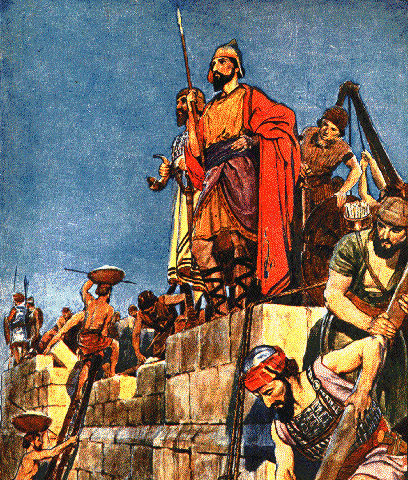
    Leadership From the Wall #4

    Leaders Are Discerning (Nehemiah 6)


    Sanballat and Geshem sent to me, saying, “Come and let us meet together at Hakkephirim in the plain of Ono.” But they intended to do me harm. And I sent messengers to them, saying, “I am doing a great work and I cannot come down. Why should the work stop while I leave it and come down to you?” (Nehemiah 6:2-3 ESV)

    Nehemiah wasn’t fooled by the tricks of the enemy, they were offering now to help with the rebuild and cease opposing its progress. Most leaders may have been excited to see the new change in the opposition, but not Nehemiah. Nehemiah discerned their true and ultimate intention was to harm him, not to help him. I enjoy what Warren Wiersbe says on this matter:

    “Once the enemy gets a foothold in a ministry, he starts to weaken the work from within; and ultimately, the work will fail. While cooperation in the Lord’s work is a noble thing, leaders must take care that they cooperate with the right people at the right time for the right purpose; otherwise they may end up cooperating with the enemy. Satan is a master deceiver and has his servants ready to join hands with God’s people so he can weaken their hands in the work (2 Cor. 11:13–15).” (Wiersbe, 1996, pp. 71-72)

    There is great strength in the denial of help, when we can discern the outcome of such partnering. This reminds me of the city of Pittsburgh and the casino they allowed to be built. The thought was that it will boost the economy, which it has. Yet, the leaders failed to see further down the road than just “the now”. We now have gambling as a city addiction. Once casinos roll in, soon other things begin to creep in like: more drug use, sex trafficking such as prostitution, gambling addictions and more alcohol consumption. In the long run, this casino may in fact be the assistant to helping the City of Pittsburgh go south.

    Nehemiah could tell that these old enemies although they were playing nice now would soon become his enemies again after they “help” rebuild the wall.

    “And I understood and saw that God had not sent him, but he had pronounced the prophecy against me because Tobiah and Sanballat had hired him. For this purpose he was hired, that I should be afraid and act in this way and sin, and so they could give me a bad name in order to taunt me”(Nehemiah 6:12-13 ESV).

    Nehemiah was a discerning leader in more than one instance, here we see him seeing the true person who sent a person to him. He saw that this certain man was not indeed sent by God and that what his words were false. Leaders need to know which people to listen to because it could spell disaster for us in the future if we listen to the wrong people. Here we see Nehemiah discerning the voice to be not from God and we should pray for the same discernment in our own lives. I’ve seen a lot of leaders listening to “Wormtonuge” and not listening to God and in so doing have shipwrecked their leadership roles and the churches they were leading.

    Here, I think the illustration of counterfeit money comes into play. The police force in charge of detecting counterfeit money in order to determine what is counterfeit and what is real study the real money closely. They spend time learning it, understanding it and they have a deep rooted understanding of the real thing. This deep knowledge of the real deal helps them to easily spot that which is fake. When we spend intimate time with the Lord and get to hear His heart beat and allow His Spirit to speak deeply into our lives, we, like Nehemiah will be able to very quickly determine or discern that which is fake. This thought and idea challenges me to become intimate more and more with my Lord, so when a person “not from the Lord” appears in my path with some “direction” I will be able to quickly determine whether or not they are from the Lord.

    Nehemiah’s intimacy with the Lord was directly connected to his intimacy with the Word of God! Warren Wiersbe says: “Nehemiah rejected Shemaiah’s proposal because it was contrary to the Law of Moses. It was forbidden for a layman to go beyond the altar of burnt offering at the temple. “The outsider who comes near shall be put to death” (Num. 18:7, NKJV). When King Uzziah tried to invade the holy precincts, God smote him with leprosy (2 Chron. 26:16–21). Nehemiah knew that Shemaiah was a false prophet because the message he delivered was contradictory to the Word of God”. (Wiersbe, 1996, p. 76)

    Leaders Remember God’s Goodness (Nehemiah 9)

    Nehemiah chapter 9 is all about repenting and remembering the goodness of God. After rediscovering the Word of God in Nehemiah chapter 8, the people realize their own sin and the Goodness of their God. The Law spoke so deeply to their hearts that they realized just how sinful they have become and they had no more reason to be confused about God’s seeming have abandoning them, which of course he didn’t…he simply removed his blessing and allowed them to become captured. This deeper understanding of God’s Word then turned them back to their God and chapter 9 recounts this beautiful turning back. All of this, the Law reading and the repenting were led by Nehemiah. Nehemiah was a man who knew his faults and sins and realized his complete and utter dependence upon the Lord. The entire book is littered with Nehemiah confessing his dependence upon God and how it was God (not himself) that was doing the work of rebuilding and doing the work of allowing the rebuilding to happen. His dependence and confession thereof is a beautiful picture of leadership. We must recognize the goodness of God in gifting us with the abilities we have. We can’t claim our gifts…we had no choice in the matter, God chose and the Holy Spirit delivered those gifts. Nehemiah recognized this and his example caused the entire nation to confess their own junk and in turn remember the goodness of God by recounting aloud his wonderful works!

    Leaders Sign First (Nehemiah 10)

    After the repenting and remembering the goodness of God, the leaders decided that they were going to make a covenant to follow the law. This they would declare to the people of Jerusalem and sign a document in front of them all proving the seriousness in what they were about to undertake. Seeing the severity of their sins and the great goodness of God convicted them to change their lives and the leaders decided to go first. The great thing I notice in chapter 10 is that at the top of the list, #1 is Nehemiah…he signed the document first! This may seem like a small principle of leadership or a small gesture by Nehemiah, but I think it speaks volumes! If God is calling for a change and the leaders feel convicted about the need to make the change…the leaders step up and change first. This is so not only to let the people see that it’s possible, but to assure the people that they as leaders aren’t asking of the people anything that they themselves aren’t willing to do.

    When I was in college and for a time after I worked in the restaurant business as a server and had many managers above me. The managers that worked at Chili’s with me were men who would ask their staff to work harder or do more stuff, or pull their weight more but they themselves were unwilling to do that themselves. Many servers lost respect for these “leaders” and in so doing became lazier then they were before! Leaders who call for change, whether radical or not must be willing to make the change first and like Nehemiah sign the covenant of change before anyone else does.

    Leaders Celebrate Wins (Nehemiah 12)

    “And at the dedication of the wall of Jerusalem they sought the Levites in all their places, to bring them to Jerusalem to celebrate the dedication with gladness, with thanksgivings and with singing, with cymbals, harps, and lyres.” (Nehemiah 12:27, ESV)

    Lastly in the book of Nehemiah I see a leader who celebrates wins. Leaders need to show emotion when things go right, there must be a celebration when we come to the completion of a project and see what the Lord has done. It’s really cool to see the excitement that Nehemiah and the people have at the end when the wall is successfully rebuilt. Not only was the wall built, but God changed the hearts of the people through the building of the wall…that’s something worth celebrating! I have experienced in the church a lack of celebration for what God does, too often we chock it up as normative and ignore the wins that God sends our way. I think this is wrong and I enjoy seeing the recognition here in the book of Nehemiah! I believe that we as leaders need to be more positive and find wins (not making them up mind you, but real live wins) where and when we can and then celebrate them! When we start leading with celebration at what God is doing and has done the people will be spurred on and re-ignited and they will remember the God-task they are on while following the leader!

    I always say to my youth leaders that I am so excited during youth group because I desire to spur my teens on through my excitement: if I’m excited they’ll be excited, but on the other hand if I’m not excited, they won’t be either. Celebrating wins helps us be excited and in turn our flame of excitement will ignite others around us and the work of God can advance all the more!

    As can be seen, there are many leadership principles which come forth in the book of Nehemiah. This book has been an inspiration to me and I know that by the help of the Holy Spirit I hope to implement all of these leadership principles into my own life and leadership.

    Tuesday, October 19, 2010

    Leadership From the Wall #3

    Leaders Delegate (Nehemiah 3; 7:2)


    In chapter 3 of Nehemiah’s book, we see a long list of people doing different things. This can be a boring list of names and jobs but in it, we see a very real and practical leadership/administration principle: Leaders delegate. A Leader can’t get things done alone, this is why he/she casts vision: to get others on board so they can help make the vision come to be. Without people following you, you aren’t a leader. A leaders job is to cast vision, then manage the vision coming to fruition. It’s as John Maxwell says in his book Developing the Leaders Around You “A leader’s success can be defined as the maximum utilization of the abilities of those under him” (Maxwell, p. 15). Nehemiah couldn’t have built a city wall by himself; to try would have been foolish. He needed people around him and he needed to pour into these people the vision and mission of what was to come.

    Nehemiah, we can see was able to rally several people to the cause and also give them specific jobs. Maxwell says that leadership is influence and to a degree, I agree with him and I think in this type of leadership role, Nehemiah had to have a ton of God given influence. Like Maxwell says in Developing the Leaders Around You: “Leadership is influence. Every leader has these two characteristics: (A) he is going somewhere and (B) he is able to persuade others to go with him” (Maxwell, p. 49). Nehemiah needed to be able to persuade people to follow him in order for him to delegate. Again, as we can see in Chapter 3, he was able to do this.

    Along with this idea of delegation, a leader must know who to place where. In Nehemiah 3, we see certain people doing certain jobs. Nehemiah must’ve known who would work best where and so he placed them in their area of strength in order to get the job done to the best of their ability. This also means, that Nehemiah knew the people well enough whom he was leading to put them in their areas of strength! He took the time to assess each individual to then place them where they needed to be. This is a powerful lesson in leadership! We, if we are to be good leaders need to know the people we are leading so we can fit them into the role they can work best in!

    Lastly, this area of delegation shows us that each individual had their own task to complete. Not everyone can do everything and each person needs to be assigned a specific job that only they can do. This creates unity as well as autonomy. People need to feel needed and when they don’t, they jump ship. A perfect example of this (albeit unhealthy) was a guy named Jimmy T. on the recent Survivor show. This guy needed to be needed and when he didn’t feel needed, he unwittingly sabotaged his team. He felt his gifts weren’t being used, so he complained and whined and brought the whole of his team to his sad level. He couldn’t function on a team where he felt unnecessary. Although he was a bit paranoid, the truth of his feelings rings true and every leader needs to learn this lesson of people needing to feel needed. Nehemiah made sure that each person who he was leading had their specific role where they could shine and do their work well.

    Leaders Deal with Opposition (Nehemiah 4 & 6)

    When God uses people to do great things, or when great things are done there will almost always be opposition. The wall to the enemies of the Israelites represented stability and safety and so when they saw great progress being made on the wall, they were angry (Neh. 4:7); “And they plotted together to come and fight against Jerusalem and to cause confusion in it” (Neh. 4:8 ESV). They were going to mess up this progress that was happening in Jerusalem, it was not going to happen on their watch, but God often defies the desires of sinful men!

    Nehemiah knew how to handle this type of opposition and he was ready for it! Once he saw what the enemies of Jerusalem were plotting, he gathered people together to pray. As a leader, he knew he was also a follower of God; he knew his role and sought God for advice. God had asked him to build the wall, so God must have a plan to protect the wall from being destroyed again!

    After praying, Nehemiah came up with a battle plan: set a guard day and night as protection (Neh. 4:9).

    So in the lowest parts of the space behind the wall, in open places, I stationed the people by their clans, with their swords, their spears, and their bows. And I looked and arose and said to the nobles and to the officials and to the rest of the people, “Do not be afraid of them. Remember the Lord, who is great and awesome, and fight for your brothers, your sons, your daughters, your wives, and your homes” (Nehemiah 4:13-14 ESV).

    He also set up people ready to fight and we hear that this frustrated the plans of their enemies (Neh. 4:15). This battle plan stopped their enemies in their tracks, because the Jews were ready to fight when their enemies expected them to be vulnerable while building. However, Nehemiah didn’t rest assured with just frustrating their plans; he insured the safety of his people. Once opposition came and left, he wasn’t under the delusion that it wouldn’t pop up again; in fact he readied his people for it to happen at any moment! He prepared them with weapons as well as a plan of action if some more opposition were to creep up on them.

    From that day on, half of my servants worked on construction, and half held the spears, shields, bows, and coats of mail. And the leaders stood behind the whole house of Judah, who were building on the wall. Those who carried burdens were loaded in such a way that each labored on the work with one hand and held his weapon with the other. And each of the builders had his sword strapped at his side while he built. The man who sounded the trumpet was beside me. And I said to the nobles and to the officials and to the rest of the people, “The work is great and widely spread, and we are separated on the wall, far from one another. In the place where you hear the sound of the trumpet, rally to us there. Our God will fight for us” (Neh. 4:16-20 ESV).

    Nehemiah prepared his people for more trouble and this preparing of his people is a great principle for leadership! We as leaders need to see this principle of leadership and apply it, because we need to prepare our people for opposition and show them how to deal with it when it comes. This may not ring as true in the business world as it does in the ministry world but none-the-less it is a great principle.

    We in church leadership are going against our enemy just by being there and so we must expect opposition to come. It is then upon us to lead our people through opposition and help them through it as well as preparing them for when it comes. Satan is a lion, waiting for his prey (1 Peter 5:8) and God’s people need to know how to have a hammer (to do the work of God) in one hand and a sword (to fight off the enemy) in the other. This picture is one that rings true for the Christian life and we as leaders should be helping the people we lead how to live with the expectation of opposition and give them to tools to fight it.


    Wednesday, October 13, 2010

    Leadership From the Wall #2

    Leaders are Bold (Nehemiah 2:1-8)


    In these verses, we see Nehemiah putting feet and action to his prayers to God. He boldly asks the king if he may go and rebuild the wall that had been destroyed in Jerusalem. This was a bold request because not only did he ask for leave to go and rebuild it, but he asked for help in getting it done. He needed the king’s help in getting the wall built and knew he would have to ask for this help. But as Nehemiah says: “And the king granted me what I asked, for the good hand of my God was upon me” (Nehemiah 2:8b ESV emphasis mine). This reminds me of a statement in Jesus on Leadership where Wilkes makes the statement, “Good leaders cultivate the ability to read current events and thus have a strong sense of what the future may bring” (p. 65). I believe because of Nehemiah’s care and prayer, he was able to foresee that the king would grant his request. He read the current situation well. Nehemiah, during the discussion prayed as well (Neh. 2:4) so as to ensure the time was right and to seek God’s blessing.

    Leaders Assess the Situation (Nehemiah 2:13)

    “I went out by night by the Valley Gate to the Dragon Spring and to the Dung Gate, and I inspected the walls of Jerusalem that were broken down and its gates that had been destroyed by fire”(Neh. 2:13 ESV).

    Nehemiah took the time to see what it was he needed to do before he did it. Good leaders take the time to assess the situations they are in and don’t just rush in and try to fix things. This is a lesson I personally need to learn. I love to rush into things without thinking and without assessing the situation. Generally I have a good sense of what must be done but have no inclination towards the steps to get there unless I sit down and assess the full picture. Too often in my life I have rushed into things and have hindered the progress of getting things done. Nehemiah didn’t make that mistake. He didn’t rush it nor did he cause anyone to freak out. He simply took time out to go and inspect the walls to see what needed to be done. He took stalk in the places that needed extra care and the places that would be quick and easy to rebuild.

    In my limited experience, I’ve seen and heard of pastors getting fired because they tried to rush change. Too many spiritual leaders, like me can see the situation and know where things need to change and be rebuilt, but they don’t usually take the time to assess the whole situation. This has resulted in them leaving by force or by desire because of the lack of simply assessing the situation. Warren Wiersbe says a few things as well on this idea.

    “Investigating (Neh. 2:11–16). After his long difficult journey, Nehemiah took time to rest; for leaders must take care of themselves if they are going to be able to serve the Lord (Mark 6:31). He also took time to get “the lay of the land” without arousing the concern of the enemy. A good leader doesn’t rush into his work but patiently gathers the facts firsthand and then plans his strategy (Prov. 18:13). We must be “wise as serpents” because the enemy is always watching and waiting to attack. (Wiersbe, 1996, p. 30)

    Leaders Cast Vision (Nehemiah 2:17)

    “Then I said to them, ‘You see the trouble we are in, how Jerusalem lies in ruins with its gates burned. Come, let us build the wall of Jerusalem, that we may no longer suffer derision’” (Neh. 2:17 ESV)

    Nehemiah has taken the time to assess the situation, has taken the time to care about these people and has taken the time to pray to ask God what must be done. Finally, he is ready to cast the vision to the people and get them on board with the mission. His steps were deliberate and wise. He didn’t rush into telling them what must be done and how he Nehemiah was going to do it. He took the time to patiently seek the Lord and to patiently see what ought to be done and think through how best to get it done. He casted vision but not prematurely and in a way that rallied the people around the vision.

    Wilkes says: “Leadership begins when a God-revealed mission captures a person” (p. 19) and I believe that the God-revealed mission has captured Nehemiah and he is ready to start working on the rebuilding of the wall. He can now, captured by the vision, perfectly articulate that vision to the people and speak of it in such a way that people can see the end result. It’s as Wilkes said of Jesus “Jesus articulated his mission in order to define what he was as Messiah. Where and how he led flowed from a clear sense of why he had come in the first place…he led with a vision of what things would look like when he completed that mission” (p. 11).

    Saturday, October 9, 2010

    Leadership From the Wall #1

    The book of Nehemiah is chock full of amazing leadership lessons for anyone to glean wisdom from. Nehemiah was a man who cared about his people, loved the name and fame of God and he was a man who was willing to stand in the gap. Leaders who go out of their way to stand in the gap for others shows not only humility but a deep concern for people over production, which when we study the Bible as a whole we see is the very heart of God. God cares more about our hearts than he does our behavior and Nehemiah was a man who cared for the people.


      My next series of blog posts will be a highlighting of the amazing leadership principles which come out of the life and book of Nehemiah!  There is so much to glean from, so I hope you enjoy this as much as I do!  Today, we will highlight Nehemiah 1 and see what we can grab from it's contents with the eye on Leaderhip Principles.

    Leaders care about their people (Nehemiah 1:2-3)

    “… that Hanani, one of my brothers, came with certain men from Judah. And I asked them concerning the Jews who escaped, who had survived the exile, and concerning Jerusalem. And they said to me, ‘The remnant there in the province who had survived the exile is in great trouble and shame. The wall of Jerusalem is broken down, and its gates are destroyed by fire’” (Nehemiah 1:2-3 ESV).

    Nehemiah took the time out of his life to ask how things were going in his home country. He was a cupbearer who was living off of the luxury and dollar of the king, he didn’t need anything from the people of Israel, but he cared enough to ask how they were and how things were going. In his book Be Determined, Warren Wiersbe says:

    “Why would Nehemiah inquire about a struggling remnant of people who lived hundreds of miles away? After all, he was the king’s cupbearer and he was successfully secure in his own life. Certainly it wasn’t his fault that his ancestors had sinned against the Lord and brought judgment to the city of Jerusalem and the kingdom of Judah. … Nehemiah was the man God had chosen to do those very things (Wiersbe, 1996, p. 14)!

    In Nehemiah, we see a man who cared about others. He set his own life aside and jumped in with his life to help his people rebuild the wall. Nehemiah didn’t need to ask about the people, he simply had a natural inclination towards caring about his people. As Warren points out here, Nehemiah’s life was set. Nehemiah didn’t need anyone or anything, much less the need to worry about other people. Many people, left to themselves if they were in a similar situation as Nehemiah would’ve sluffed off the worry about other people and would’ve lived their lives in manner unto themselves.

    This is a great attribute of a good leader. If we are leader of people and do not care about our people and we simply live our leadership life to get ahead for ourselves, we stop being a leader and start being a dictator. Our early picture of Nehemiah shows the type of leader he will show himself to be: one who cares deeply for others.

    Leaders pray (Nehemiah 1:4)

    As soon as I heard these words I sat down and wept and mourned for days, and I continued fasting and praying before the God of heaven. (Nehemiah 1:4 ESV)

    Nehemiah doesn’t simply care for people and leave it there; he goes before the almighty God on their behalf! He prays for them and enters into their pain with them, even though he himself is not really near it. This shows the heart of a leader who is willing to stand in the gap for his people! Great leaders (spiritual or not), if they believe in Jesus Christ should be praying leaders. If we claim that Jesus is our “all in all” yet we don’t ask Him to assist us and those we lead we are simply giving lip-service to a faith that has now bearing in our real life. That may sound harsh but I think it’s true and the sad fact is that in the American church, a praying pastor is something that is lacking. That is poor leadership that makes no sense at all: a spiritual leader who is supposed to lead people towards a deeper faith and knowledge of God spends little to no time with the Lord? How is that possible to then lead people to God?

    This is what Wilkes, in his book Jesus on Leadership would call “and act of submission” and the first step towards servant leadership. Wilkes says: “Submission to God and to the divine mission for your life is the first step to servant leadership” (pg. 22). Nehemiah by praying was seeking the best of others, not himself. When we pray as leaders, we are seeking what God would have us do for Him and for His people, not ourselves. When we lead in this way, we are acting as Jesus did in the capacity of servant leaders.

    Nehemiah didn’t just stop at a simple prayer either; he stood in the gap for the people. He sought their best and asked God to forgive them their sins.

    Leaders Intercede for others (Nehemiah 1:6)

    “Let your ear be attentive and your eyes open, to hear the prayer of your servant that I now pray before you day and night for the people of Israel your servants, confessing the sins of the people of Israel, which we have sinned against you. Even I and my father’s house have sinned” (Nehemiah 1:6 ESV).

    Nehemiah cared enough to not only do a simple prayer for them, but like a priest he interceded for them before God. He went to the Living God and asked Him for mercy upon the people. Leaders care enough to pray for their people in this way. This type of praying for leaders can go a long way with their leadership not only because it trains them to become better prayers but also because it helps them to be tenderer towards the people they lead. There is always a need for a harsh word spoken in love for sure, but there is also a time for tender intercession where we as leaders seek God’s forgiveness of them. While reading this idea of leadership from Nehemiah, I am struck with the reality that I rarely do this for my people. I am convicted by Nehemiah’s example and desire to be a leader who intercedes for the people I lead!

    Nehemiah was also claiming the promise from 1 Kings 8:29; 2 Chron. 7:14 that God would be attentive to the prayers of His people. Warren Wiersbe in his book Be Determined says:

    “The greater part of Nehemiah’s prayer was devoted to confession of sin (1:6–9). The God who promised blessing and chastening also promised forgiveness if His people would repent and turn back to Him (Deut. 30; 1 Kings 8:31–53). It was this promise that Nehemiah was claiming as he prayed for himself and the nation. God’s eyes are upon His people and His ears are open to their prayers (1 Kings 8:29; 2 Chron. 7:14)”. (Wiersbe, 1996, pp. 17-18)

    Again, I feel like this all comes back to the idea of “Servant Leadership” which Wilkes talks about. Nehemiah was humbling himself before God and going before Him on their behalf. He wasn’t caring about himself or what others thought of him, he was simply reaching out to the Almighty God for the people. I like what Wilkes says in his book: “As long as leaders are worried about who sits at the head table, they have little time for the people they are called to serve” (p. 36). This was a statement about not caring how important you are as a leader but how important the people are you are leading. As leaders, we must put the people we serve ahead of ourselves.

    Friday, May 21, 2010

    Serpentine Jesus

    The thing I love about the Bible is that it tells several stories that all end up telling the same macro-narrative of Jesus.

      Genesis-Revelation tells the story of a lost, fallen humanity and their need of a Savior.  These books also tell of the rescuer: Jesus and how he from the beginning was meant to come and rescue the world.

      The book of Numbers gives a great glimpse of what I'm talking about:

    From Mount Hor they set out by the way to the Red Sea, to go around the land of Edom. And the people became impatient on the way. And the people spoke against God and against Moses, "Why have you brought us up out of Egypt to die in the wilderness? For there is no food and no water, and we loathe this worthless food."  Then the LORD sent fiery serpents among the people, and they bit the people, so that many people of Israel died.  And the people came to Moses and said, "We have sinned, for we have spoken against the LORD and against you. Pray to the LORD, that he take away the serpents from us." So Moses prayed for the people. And the LORD said to Moses, "Make a fiery serpent and set it on a pole, and everyone who is bitten, when he sees it, shall live." So Moses made a bronze serpent and set it on a pole. And if a serpent bit anyone, he would look at the bronze serpent and live. (Numbers 21:4-9 ESV)

      Many people at first glance would look at this story and not think much of it.  In fact I myself didn't think much of it for many years (except maybe that this story is where we get the symbol for healthcare seen right side below )

      This story is in fact also a precursor to what would happen to Jesus.  He would be raised up on a cross and all who look to Him will recieve Salvation. He says so in His conversation with a rich Jewish leader named Niccodemus: "And as Moses lifted up the serpent in the wilderness, so must the Son of Man be lifted up." (John 3:14 ESV)

      God's narrative in the Bible is amazing to behold.  Seeing the familiar patterns and the arrows pointing over and over again to Jesus are staggering.  No one, and I mean now one could have imagined the sheer depth of detail that God went through to point to Jesus.

      Let's look at a few other details in the Old Testament that can easily be seen as pointing to Jesus:

    1. The Passover
    2. The Sacrificial System
    3.  The Suffering Servant from Isaiah 53
    4. Numerous Psalms all describing a coming savior who wouldn't see death
    5. The Prophecies that Christ fulfilled

      Literally I could go on and on and I know I didn't even add in all the the "most important" arrows pointing to Christ.  My simple point in this simple post is that Christ is the center of the Bible.  God is the main Character and he desired to make known Himself in the manifest body of Christ, thus the Son was thrust into the shining light of the whole Bible.

      Jesus said: "Jesus said to him, "Have I been with you so long, and you still do not know me, Philip? Whoever has seen me has seen the Father. How can you say, 'Show us the Father'?" (John 14:9 ESV)

      Seeing Him is Seeing the Father.  Seeing Him is Seeing the Holy Spirit.  In Jesus we see the mainifestation of God to His people, loving them to DEATH...literally.

      He has brought about healing for our souls from the cross, for when we look upon the Raised up Christ he heals our souls and when we gaze upon the ressurected Christ we see our Salvation.

      It's pretty cool looking at the Scriptures through the lens of Jesus because when  you do the more "hidden Jesus code" you find and the more the Scriptures POP with awesome strength!

      The whole Bible tells the story of Jesus, when we connect to the Bible, we connect to Jesus, who is in fact God.  God's story is His Story, revealing to us who He is and how it is we can know Him better...which allows us to know ourselves better in turn.

    Monday, May 3, 2010

    The Omniscience of God

    O LORD, you have searched me and known me! You know when I sit down and when I rise up;

    you discern my thoughts from afar.
    You search out my path and my lying down
    and are acquainted with all my ways.
    Even before a word is on my tongue,
    behold, O LORD, you know it altogether.
    You hem me in, behind and before,
    and lay your hand upon me.
     Such knowledge is too wonderful for me;
    it is high; I cannot attain it. (Psalm 139:1-6 ESV


      God cannot learn. This is an idea of God's omniscience I had never pondered before today. There is no new knowledge to God; nothing can be added to his knowledge, for He is aware of all knowledge.
    A.W. Tozer in his book The Knowledge of the Holy puts it this way: "To say that God is omniscient is to say that He possesses perfect knowledge and therefore has no need to learn. But it is more: it is to say that God has never learned and cannot learn." (Tozer, 1961, p. 55)

    We as humans have a tough time grasping this truth. We can state it as "God knows all" but when we say it in a negative form like: "God cannot learn," something in us tweaks and has trouble now grasping something we thought easily grasped. We as finite human beings always learn and are always learning. Our brains take in and give off so much information that to say someone can't learn is so foreign we balk at the very thought of it.
    Yet God is so knowledgeable that learning is impossible, for God to learn would be for God to admit he didn't know something and that some other being had information He Himself did not possess. It would be to admit flaw and the Bible says that God is perfect and without flaw. (Matthew 5:48)

    Tozer, in The Knowledge of the Holy also says: "We have seen that God had no origin, that He had no beginning that He requires no helpers that He suffers no change, and that in His essential being there are no limitations." (Tozer, 1961, p. 56)

    Tozer here is going through the list of attributes of God in which he already discussed in the book, but when you look at this list, God is so other than us! He is so close, yet so foreign, so attainable yet so unattainable. He is Holy, set a apart and so hard to conceptualize. These attributes especially that of Omniscience is what I believe causes hang ups for those who don't believe.

    How can we be made in God's image, yet Him be so foreign some may ask. My answer may not be the best, but it's simple: we have to have faith that it is true, we all believe in something and having a being who created everything in this world not be unattainable seems awkward at best. I mean think about it: this world has been here for at least 10,000 years and we still have no clue as to how all things work. Why would we expect to know the maker?

    God's omniscience freaks me out a bit, but it is also very amazing to think that He knows so much that He can never learn anything!

    I love that God is a mystery. I love that I can't box him up and put a bow on Him. I love that He is so very "other" (or Holy) that I can't even scratch the surface of who He is. He graciously gives us glimpses as to His true nature...but even those revelations stump us and make us dig deeper! Oh how I love that about God! Plunging the depths of His ways, plunging headlong into the bosom of who He is, drowning in the wealth of it! It's unparalleled in its amazing-ness!

    A.W. Tozer was a man of a great wealth of knowledge and he has even today, some great insights on who God is, was and will forever be.  Tozer discusses how easy, yet hard it is to understand the omniscience of God and says it is easier for us to understand these deep truths by thinking in what God is "not" rather than what "God is."  To illustrate this, he says in The Knowledge of the Holy " And that abrupt statement by God Himself, "I am the Lord, I change not,"[Malachi 3:6] tells us more about the divine omniscience than could be told in a ten-thousand word treatise, were all negatives arbitrarily ruled out." (Tozer, 1961, p. 56)

     I agree, Tozers negative statement: God cannot learn caught my attention and made me better understand God's omniscience!  God is deep, vast and Holy!  We serve a Mighty God!

    Friday, April 2, 2010

    What did Christ Accomplish? (Pt. 1)

    Today is Good Friday, a day that is set aside to celebrate the death of Jesus Christ. It is called "good" because of His death.


    Some ask: "Why would you celebrate a day whe someone dies? Isn't that mean? Why does that make you want to celebrate?"


    The answer is simple: Christ died so we could live! His death was the atoning sacrifice for our sins. By his death He has also brought about our Justification and Sanctification!
    Well, that answer is simple, but let's unpack atonement. (In the following two posts in this series we will unpack Justification and Sanctification)
    To unpack Atonement (as well as Justification and Sanctification) you have to start by asking questions and seeking the answers to those questions. 

    First is: "What's atonement mean?"
    Atonement is the act of forgiving a deserved punishment. Because we all have sinned, we deserve death (Romans 3:23; 6:23), However, our sins were atoned for, not by human effort, but by the wounds of Christ (1 Peter 2:24). The requirement for said atonement was blood of a pure sacrificial lamb or bull (Lev. 2) Which Christ became for us and he spilt his blood on our behalf. His righteousness, covered our unrighteousness, so we may be brought before God blameless and pure. (1 Peter 3:18; 2 Corinthians 5:21)


    Where did the plan of atonement originate?
    The plan of atonement originated directly after the fall. In Genesis 3:15, God says to Satan: “I will put enmity between you and the woman, and between your offspring and her offspring; he shall bruise your head, and you shall bruise his heel.” This is known as the first mention of the Gospel. God is talking about how Christ will come and be bruised, but will do far more damage to Satan than Satan will do to Him. God already had this sacrifice in mind in order to reduce Satan to nothing.


    Why would God want to provide atonement for us?
    We see the main attribute of God that pushed Him to provide the atonement in John 3:16 being Love. It says: “For God so loved the world, that he gave his one and only son…” His reason for giving his son was His love. 1 John 4:8-10 also says this very thing: that is was God’s love that motivated him to sacrifice Christ on our behalf. In Leviticus 2, we see that because of God’s wrath and hatred towards sin, the sin must receive atonement. He gave the people of Israel a means of this atonement through the sacrifice of animals and using their blood to atone their sins. God’s wrath demanded payment for the sins committed, this then was the second impetus, which moved God to provide atonement. His wrath towards sin could be propitiated; this is why Christ is also called our propitiation. (1 John 2:2 ESV)


    Why do we even need atonement?
    Man is all together sinful. When Adam ate of the tree, he signed the death warrant of all humanity, damning us to a sinful nature from birth. (Gen. 3). Romans 3:23 states: “for all have sinned and fall short of the glory of God” Psalm 14 and 53 also show the utter depravity of man, as cited from Romans 3. This sinful nature cuts us off from a perfect God, who is light and in him is no darkness, which is sin. (1 John 1:5-10). This cutting off created a void between us and God that needed to be filled, or bridged so we could again meet with our Lord. In all reality, in His perfection he could’ve walked away without caring, but in Lev. 2, he sets up a sacrificial system and a law system in which an can learn deeper how depraved they are, yet still have the atonement to bring them back to the Lord. To make an eternal atonement, Christ had to die. The perfect lamb, without blemish or spot had to suffer in order for us to live (Isaiah 53).
    How could God justly put man’s sins upon an innocent victim?
    This question almost assumes that Christ was forced into being the ultimate sacrifice, while in fact he was a willing vessel. Justly, for the sins to be forgiven through Christ death he had to have volunteered for this position. Had he not been willing, the atonement would never have happened. In Philippians 2:5-10, we see Christ’s humility in stepping down to this task and role. We also see in the Garden of Gethsemane, in Matthew 23, Christ wrestles with His calling, but undoubtedly bends to the will of the Father. Christ was willing to be the suffering servant that Isaiah 53 talked about. He was led before the shears and was silent, he did not speak out about them being wrong. The innocence of Christ was also key. Had he been blemished by sin, the atonement would have been meaningless, for a tainted sacrifice will not appease the wrath of God.


    What qualified Christ for being such an offering?
    Christ being both God and man as well as sinless qualified him as this offering. He is eternal, so His death would ring throughout eternity and his resurrected hands would be a constant reminder to God the Father of Christ’s sacrifice on our behalf. He was also Human, so he dealt with each and every temptation that we did, yet did not sin (Hebrews 4:15). He overcame by living life through the power of the Spirit (Matthew 3-4), which is also our example as how we should now live. He humbled Himself and was willing to be the offering which would appease the wrath of God as well as atone for our sins. (1 John 1:5-10; John 3:16, 1 Peter 3:18; 1 Peter 2:24)


    Could anyone other than Christ have made an acceptable offering?
    No


    How do we know that Jesus was an offering that was acceptable to God?


    Scripture is full of assurance that this offering was acceptable. First is the very fact that God in Matthew 27:46-47 turned his back on Christ, symbolizing Christ’s receiving of the sins of the entire world. It was such a wretched sight that God the Father had to separate Himself from seeing it! Also, after the death of Christ, in Matthew 27, we see the curtain which blocked the view of the Holy of Holies from view torn in two. This represented now that all men due to the atoning sacrifice of Christ have full access to God. Christ during his life in John 14:6 also said: “I am the way, the truth and the life no one comes to the Father accept through me”. This would give the reader the idea that Christ was and is enough. Also, we see throughout the epistles constant reassurance that Christ’s atoning death was sufficient to cover over all the sins of the world. 1 Peter 3:18 “For Christ died for sins once for all, the righteous for the unrighteous, to bring you to God. He was put to death in the body but made alive by the Spirit,” His righteous sacrifice was sufficient! 1 John 2:2 says: “He is the atoning sacrifice for our sins, and not only for ours but also for the sins of the whole world.”


    Is there any limitation concerning who may benefit from the atonement of Christ?
    The answer to that truly lies in a persons view of Calvinism. The Scriptures say that it was for all the world 1 John 2:2; 1 Peter 3:18. However, there is a view that God chooses only certain people to receive this said blessing of atonement. I believe that it is for all the world as the Scriptures clearly state, yet people still choose wickedness over righteousness. We can see this perfectly within the picture of the two thieves crucified with Christ. The atonement as attainable for both, but only one chose to accept it. The other chose to spit on it. Christ’s atonement was once for all.


    Can the atonement in any way be effective in human lives where the gospel is unknown?
    Romans 1:18-20 says: “The wrath of God is being revealed from heaven against all the godlessness and wickedness of men who suppress the truth by their wickedness, 19since what may be known about God is plain to them, because God has made it plain to them. 20For since the creation of the world God's invisible qualities—his eternal power and divine nature—have been clearly seen, being understood from what has been made, so that men are without excuse.” The atonement can and is effective throughout the world, whether or not they’ve heard the message. However, to make things more clear to the world we live in, we as the followers of Christ are called to go and make disciples.


    Christ is our atoning sacrifice...that is some encouraging stuff!  No wonder we celebrate his Death!  Tomorrow, we will unpack Justification and on Sunday we will unpack Sanctification...as well as the Ressurection!

    Friday, March 12, 2010

    Laughing at Jesus

    I'm sure you remember what it's like to be laughed at, I know I do. It's the moment you say something or do something and someone thinks it would be a great time to laugh at you for your words, or your actions. Have you ever thought that God was laughed at? When someone laughed at you, what was your response? What do you think God's response would be?


    These and many more questions piled into my brain as I was reading through Luke's Gospel. Here, we see Jesus getting laughed at and ridiculed...before the cross! Here's the story from Luke 8:49-56

    "While he was still speaking, someone from the ruler’s house came and said, "Your daughter is dead; do not trouble the Teacher anymore." But Jesus on hearing this answered him, "Do not fear; only believe, and she will be well." And when he came to the house, he allowed no one to enter with him, except Peter and John and James, and the father and mother of the child. And all were weeping and mourning for her, but he said, "Do not weep, for she is not dead but sleeping." And they laughed at him, knowing that she was dead. But taking her by the hand he called, saying, "Child, arise." And her spirit returned, and she got up at once. And he directed that something should be given her to eat. And her parents were amazed, but he charged them to tell no one what had happened.

    This struck me because I never thought anyone ever laughed at Jesus. I remember when Sarah laughed at God when He told her she was going to bare a son in her old age, but I never thought someone laughed at Jesus.

    They laughed because Jesus said: "...she is not dead but sleeping". To them, they clearly saw that the girl was dead and not merely sleeping. Yet Jesus saw a girl who simply needed wakened. They laughed because they doubted anything could be done at this point. If you remember, the people from the house came out when she had died that Jesus was no longer needed because she was dead. Don't have him even bother now, this situation is hopeless.


    When I first read that they had "laughed" at Jesus I was pretty angry with them. How could you laugh at Jesus? I was thinking they must have real balls to make fun of God.


    Then I asked myself: "Has God ever said something to me and I laughed at Him?"


    When God tells me something I think is impossible, or just plain stupid (in my mind) do I not also laugh at God? Do I not also ridicule His thoughts and words to me, thinking that what He has just said to me is absurd?


    I must confess, I have indeed laughed at God. I have heard His words to me and I laughed at how silly it sounded, or how impossible it seemed. That's why Sarah laughed. She was WELL passed birthing years, yet God said you will give birth. She was WAY passed breast feeding days, yet God said she would wean her child. The only outward expressions she could show was her doubt, which came about by her laughter.

    When I think of crazy things God said in the Bible that I would've laughed at, I always come to the books of Joshua and Ezekiel. God told Joshua and Ezekiel to do some crazy, weird and wacky things. Ezekiel had to lay siege to his clay model of Jerusalem. Joshua had to march around a city seven times, and then tell the people to shout loudly (all in an effort to destroy a whole city). Ezekiel also was asked to cook a meal in front of people using his own poop! I would've laughed really hard at that (probably because I work with Middle Schoolers and "poop" is one of the funniest words in their vocabulary)!


    God may call us to crazy things that seem absolutely impossible to us. Those things may make us laugh, but God can accomplish them without flinching!


    Look at Jesus reaction to the laughter. "But taking her by the hand he called, saying, "Child, arise." And her spirit returned, and she got up at once."
    Jesus reaction was to ignore the laughter and do what he said was able to be done. He brought her back to life, or in Jesus own words: woke her up. He didn't scorn the people for laughing, nor did he defend himself; Jesus simply did His miraculous work.
    God did the very same thing with Sarah in Genesis. She laughed at God, but God didn't reprimand her insolence, nor did he defend Himself...he simply did what He said would be done.
    My take away from this obscure passage is that even when God calls me to something that is laughable to me...He will do as He says. His word is true and His word will come about in my life!

    Friday, September 25, 2009

    Prostitute Lover


    God called a man to marry a prostitute.


    She was an adulterous, cheating whore of a wife, yet God still told him to keep her as his wife and he loved her completely. Hosea was this man and Gomer was his wife.


    Hosea was told by God: "Go, take to yourself a wife of whoredom and have(D) children of whoredom, for(E) the land commits great whoredom by forsaking the LORD." So he went and took Gomer, the daughter of Diblaim, and she conceived and bore him a son" (Hosea 1:2-3 ESV).


    God wanted Hosea to marry Gomer because God desired his marriage to be a symbol to the people of Israel.


    God loves his people so deeply yet they have whored themselves out to sin, and other gods, choosing to cheat on God, as Gomer cheats continuously on Hosea. She has cheated so much on Hosea, that some of the children she bears are not Hosea's, so he names one of them "Not My People".


    This story is quite beautiful, yet extremely scandelous. Hosea is a man of God, yet he is married to a whore. The fact that she is a prostitute is well known to all around, it's no secret...in fact, I'm sure that some of the men who condemn Hosea for his marital choice are actually having sex with Gomer!


    Reading this story has always affected me, but now especially because I am married. I love my wife with all my heart, but the thought of her cheating on me sends pangs in my heart. To have that happen again and again would be unbearable.


    Love scorned, love pushed away and treated like a dirty rag worthy of only wiping a butt with is how Gomer treated Hosea.


    He loved her, sacrificed his reputation for her, sacrificed his dignity for her, even sacrificed his right to be the father of her children. All because of his love for her and his love for God.


    In reading the book "Redeeming Love" by Francine Rivers, this story has made more headway into my heart and mind.


    We are Gomer. I am Gomer.


    We/I have whored myself out to sin. I have left the one who loved me and scorned his love. God is a prostitue lover. We give him a beating yet he still loves us.


    Out of Hosea' whole story, this is what hits me the hardest: "1 The LORD said to me, "Go, show your love to your wife again, though she is loved by another and is an adulteress. Love her as the LORD loves the Israelites, though they turn to other gods and love the sacred raisin cakes."


    So I bought her for fifteen shekels [a] of silver and about a homer and a lethek [b] of barley. 3 Then I told her, "You are to live with [c] me many days; you must not be a prostitute or be intimate with any man, and I will live with [d] you." (Hosea 3:1-3 NIV)


    Hosea, knowing that his wife has once again sold herself out for prostitution goes to her pimp and buys her back! He had to buy his own wife back..and HE DID!


    She wandered away from his bed to sleep with countless men, to cheat countless times. She was now once again owned by another man...and Hosea paid the price!


    My heart aches when I read this. My heart and soul want to weep at this...yet I AM GOMER. I am not Hosea...God is. In the narritive of our lives, we are Gomer. Yet God in His love and grace comes and purchases us back. He paid the price...in blood.


    There are several more hard hitting pieces to this story and River's book based on this Biblical account which I will share. This is part one in the Series entitled "Prostitute Lover".

    Monday, August 31, 2009

    Burdenless Commandments

    The book of 1 John is amazing. I have been challenged, broken, beaten and convicted by the verses that small book contains. Recently, while on vacation, I was struck by a passage in 1 John 5, which has been a tough piece of meat to chew on.

    1 John 5:3 says: "For this is the love of God, that we keep his commandments. And his commandments are not burdensome."

    His commandments are not burdensome.

    Not burdensome. This struck me, because I never thought THAT about God's commands. In fact, when I look at some of them, I would say they put a "heavy load" upon me. They are actually meant to be without burden?

    My immediate reaction was something like: "John, are you joking? OK, I understand that following the Commandments of God are required of me, I know that they are good and right and you can determine whether or not I know God by how well I follow them...but not a burden? What are you smoking?"

    Probably not your "typical" Pastoral response but hey I would throw "typical" or "expected" out the window when authenticity can be so much better, not to mention more healing (as well as revealing).

    This verse has been going through my mind a lot recently. Taking the book of 1 John as a whole, it is a refutation of false doctrine as well as a small handbook for Christians to do heart checks as to whether they truly are following Christ, or not. It is a great book to determine whether you're a Christian or not. With that said, John while coming to the close of this book, reminds the believer the utter importance of God's commands.

    1 John 5:1-5 says:
    " 1A)">(A) Everyone who believes thatB)">(B) Jesus is the Christ has been born of God, andC)">(C) everyone who loves the Father loves whoever has been born of him. 2D)">(D) By this we know that we love the children of God, when we love God and obey his commandments. 3ForE)">(E) this is the love of God, that weF)">(F) keep his commandments. AndG)">(G) his commandments are not burdensome. 4ForH)">(H) everyone who has been born of God overcomes the world. And this is the victory that has overcome the world—I)">(I) our faith. 5Who is it that overcomes the world except the one who believesJ)">(J) that Jesus is the Son of God?"

    Loving God=Following His commands.

    Some people will take these verses and do whack job things with it. Some will say that if you sin at all, even once after conversion, you're not truly saved. This person obviously didn't read 1 John 1:5-2:2. Others will say that these verses don't say that this means what we think it means and will downplay the importance of the message.

    Legalism kills as we see in Matthew 23, but so does apathy.

    This is where 1 John 5:3 comes into play. We don't beat our chest and try to do the commandments of God by ourselves. We don't do do do...it is about surrender.

    We must first come to the point that we realize that God is our creator. Next we must realize that God Loves us more deeply than we can imagine. After we sort of grasp that (I don't think this side of heaven we will ever FULLY grasp this), we then must come to the conclusion that he (since he loves us) has our best interest in mind. This is how eventually his commandments no longer become burdensome, but blessings. It is a hard mind shift, I know I have been wrestling with it for a month and anticipate much longer!

    God created us. He knows how we work best. When he says to do something or NOT to do something...it's because doing those things or not doing those things is how we work best. He is a loving Father, with eons of life experience who knows the traps and folly that following Satan brings. He desires your best. He desires my best.

    I am praying that I can experience the fullness of this verse. Where doing what God commands is not burdensome. I need to surrender my agenda, my attempts at living this "christian life" and allow His Spirit full control. Give over the keys to my life, my thinking and my actions, falling in FAITH into His loving, caring arms!


    Thursday, July 16, 2009

    Wrestling With Predestination Pt.3

    When it comes to any Theology, there comes a time when human words must cease and the Bible must speak for itself.

    We are all flawed beings attempting to understand a deeply unfathomable God. We have our boxes, we have our tight Theological ideals...but in the end issues like predestination are as deeply mysterious as our God is. I think [I'm pretty sure] God did this on purpose. He left Himself so mysterious so we, His creation would have to seek to know the answers. We would have to be on our faces, on our knees and in the Word to come to some type of understanding.

    Imagine your on your first date with that cute girl. She ends up telling you everything about herself, flaws and all right there. She takes 4 hours to list out all the things she is good at and bad at. She tells you her quirks, what makes her tick and what ticks her off. You leave the date and all the mystery is gone...all the fun of seeking out who she is...gone.

    God is relational so he did NOT reveal himself all in one shot. In fact, no matter how long we live and how deep we go...we will NEVER end up scratching the surface of our God! OK, sorry...Predestination, right.

    What does the Bible say about this issue?

    Well, it says A TON.

    On the Arminian side, we have Scriptures that speak to God's desire for all to be saved. Mark argues that reading these simply at face value is why Arminians come to this view. Mark states that most Calvinists read these a bit deeper than do Arminians and see the words "all", "world" and "all people" as descriptive of "The Elect". I love reading Mark Driscolls books and I listen to every sermon of his...yet I wish he would've wrote more on dismissing these verses. I will list them.

    1 Timothy 2:3-4 (English Standard Version)

    This is good, and it is pleasing in the sight of God our Savior, 4who desires all people to be saved and to come to the knowledge of the truth.


    2 Peter 3:9 (English Standard Version)

    9 The Lord is not slow to fulfill his promise as some count slowness, but is patient toward you, not wishing that any should perish, but that all should reach repentance.


    John 3:16-17 (English Standard Version)

    16"For God so loved the world, that he gave his only Son, that whoever believes in him should not perish but have eternal life. 17For God did not send his Son into the world to condemn the world, but in order that the world might be saved through him.


    1 John 2:1-2 (English Standard Version)

    1My little children, I am writing these things to you so that you may not sin. But if anyone does sin, we have an advocate with the Father, Jesus Christ the righteous. 2 He is the propitiation for our sins, and not for ours only but also for the sins of the whole world.


    This last verse (1 John 2:1-2) Mark doesn't even mention. How could Christ be the Propitiation for the whole world? 1 John was a letter to believers, or if you will "The Elect". For John to say "...and not for ours only but also for the sins of the WHOLE world" seems pretty indicative of a gift that is for all, but not chosen by all.

    Another widely debated Arminian vs. Calvanist passage is 1 Peter 3:17-19. When you read a passage from different translations, you can see the camp which the translators lean towards. For example, the ESV in 1 Peter 3:17-19 says: "17For it is better to suffer for doing good, if that should be God’s will, than for doing evil.

    18For Christ also suffered once for sins, the righteous for the unrighteous, that he might bring us to God, being put to death in the flesh but made alive in the spirit"


    While the NIV says:

    "It is better, if it is God's will, to suffer for doing good than for doing evil. 18For Christ died for sins once for all, the righteous for the unrighteous, to bring you to God. He was put to death in the body but made alive by the Spirit"


    The ESV leads you to read that the death was One death for sins, while the NIV leads one to think it was once for all sins, for all people.


    However, the 1 John 2:1-2 passage is the one that really has me perplexed.


    I think Christ dying for the whole world, rather than for a select few makes more sense. The depth of heart-warming feelings I feel at being "a Chosen One" doesn't counter-react the depth of pain my heart feels at thinking "They didn't even have a chance".

    Mark explains himself well as to why his passion for evangelsim is intact, whilst still being a strong believing Calvanist, yet I feel that the Church was meant to go out and call Disciples to their Husband Jesus. The people can choose or not.

    I know that the majority of Calvanist would say its ludacrous for sinners to choose God, because we as sinners have nothing good within us, nothing good to reach out for good. Yet, I believe that God touches our hearts, warms our hearts and we can give into this or not. That warming of the heart I believe happens to all, yet most choose not to give into it.


    Again, I am not ready to deny the idea of Predestination outright. These are my honest thoughts, my gut-feelings AFTER studying the Word and reading ideals on both sides. That's why I will now list out the Biblical stance of the Calvanist side. Here are the verses that go along with this Theological view:

    Romans 8:29-30 (English Standard Version)

    29For those whom he foreknew he also predestined to be conformed to the image of his Son, in order that he might be the firstborn among many brothers. 30And those whom he predestined he also called, and those whom he called he also justified, and those whom he justified he also glorified.


    Romans 8:33 (English Standard Version)

    33Who shall bring any charge against God’s elect? It is God who justifies.


    1 Corinthians 1:27-28 (English Standard Version)

    27But God chose what is foolish in the world to shame the wise; God chose what is weak in the world to shame the strong; 28God chose what is low and despised in the world, even things that are not, to bring to nothing things that are,


    Acts 13:17 (English Standard Version)

    17 The God of this people Israel chose our fathers and made the people great during their stay in the land of Egypt, and with uplifted arm he led them out of it.


    Ephesians 1:3-12 (English Standard Version)

    3Blessed be the God and Father of our Lord Jesus Christ, who has blessed us in Christ with every spiritual blessing in the heavenly places, 4even as he chose us in him before the foundation of the world, that we should be holy and blameless before him. In love 5 he predestined us for adoption as sons through Jesus Christ, according to the purpose of his will, 6 to the praise of his glorious grace, with which he has blessed us in the Beloved. 7 In him we have redemption through his blood, the forgiveness of our trespasses, according to the riches of his grace, 8which he lavished upon us, in all wisdom and insight 9 making known to us the mystery of his will,according to his purpose, which he set forth in Christ 10as a plan forthe fullness of time, to unite all things in him, things in heaven and things on earth.

    11In him we have obtained an inheritance, having been predestined according to the purpose of him who works all things according to the counsel of his will, 12so that we who were the first to hope in Christ might be to the praise of his glory.


    There are several others, including the Biggest string found in Romans 9:1-11:36. Others include: Phil. 1:29; 1 Thess.1:4-5; Col. 3:12; 2 Thess. 2:13; 2 Timothy 2:10; Titus 1:1; 1 Peter 1:1; 1 Peter 2:4; 1 Peter 2:9 and 2 Peter 1:10.


    These verses are bold and they are many. I will go deeper into them next post. I've given a lot of food for thought and my brain is still thinking through these particular verses. The evidence for Predestination within the realm of how much Biblical content there is FOR it is hard to deny. I know I said this was going to be "more Pro Predestination" in nature...but my true colors I think have shone through :)