@marv_nelson

    follow me on Twitter
    Showing posts with label Leadership. Show all posts
    Showing posts with label Leadership. Show all posts

    Thursday, September 13, 2012

    Napoleon on Leadership- Be Honest

      I've been saying this before but Napoleon Dynamite is a literal treasure trove of leadership wealth...if you care to pick it apart!

      To the left is Pedro and Napoleon riding Pedro's sweet ride.  When Pedro takes his sweet ride out and does a jump off the ramp Napoleon says: "Wow, you got like 3 feet of air that time!"  Which was a dramatic over-statement.

      I think this is one of the best leadership lessons we can see from Napoleon and it is: "Don't over inflate...be honest!"

      Why is this such a big deal?

      Well, let's say Pedro believes Napoleon and thinks he really got three feet of air.  In his mind he may have achieved his goal and have a sense of mastery over the sweet ride he has.  He may never attempt to get better...even though he desperately needs to.  If we over inflate either our abilities or the abilities of those under our leadership, we run the risk of growth stonewalling.

      Also, it's deception.  I know, I know Napoleon was a character and his over exaggeration was hilarious in the movie but seriously, in real life, in real situations it's lying.

      Sometimes, we over inflate because we feel inadequate.

       Sometimes we over inflate because we feel the need to compete and make ourselves or our "thing" way better.

       Sometimes we over inflate because we know our "thing" or our very self is lacking and so we try to cover it up the lazy way by simply lying.

      I am well aware that the majority of my audience is Christian and that many of you reading this trust in Jesus...yet we (yeah I said we) do this.  And we need to stop it.

      As leaders we need to know we are more than adequate...not because of our abilities, but because of His.

     As leaders we need to know that we are in Kingdom work and any win for Christ (even if it's not "our" ministry) is a win for us.

      As leaders we need to know that when things in ourself or "our" ministry are lacking, lying and covering it up won't help.  We must seek Him to fulfill us, we must seek Him to enrich us and we must seek Him to help determine our steps.

      I come as one who is wrestling through this and one who is trudging through my own "issues" of over inflating.  I care way too much how it all "looks", but I must be honest.


    Friday, September 7, 2012

    Fear and Trust

    David and Goliath is one of the most well known stories in Scripture. It has so much meaning for many different reasons.

      #1 It's the classic tale of the Underdog coming out on top

      #2  It's a story of a no-name becoming famous

      #3  It became a moment that changed the history of a nation


       So many things can be brought to light within this story, but for me where I am right now in my walk, in my faith and in my "job" I saw something to do with fear and trust.

      When I looked at David and the other Israelites, I asked myself this question: "What's the difference between David and the other soldiers?"  Two words flew into my mind: fear and trust.

      You see, when the Israelites saw the Giant of over 9 feet they knew: they in and of themselves could not ever dream of defeating this Giant before them. They looked within themselves, their abilities and their skills and found themselves wanting.  For 40 days they were reminded of their inadequacy, they were reminded of the impossibilities of them being able to win. So, they feared, they whined and they hid.

      David on the other hand realized that God could do it.  He trusted in the Lord and knew God was not pleased with Goliath's taunts of not only Israel but God himself.  Goliath was defying the living God and David trusted God wouldn't let it stand.  David saw that God within him could defeat this enemy.

     David had proof to back this claim by how he saw God deliver him from the Lion and the Bear, so this Philistine was going to be nothing for David's God.

      This means so much to me, because as I look at my call as being a Campus Pastor for CMU and Pitt, I am daunted by the task.  I feel as if things are happening slow, I feel like I am not good enough to do the job in which I've been called.  Yet, I see David's trust: not in himself, but in his God.

      I, we, must switch our trust from ourselves to God because we will face something we can't handle and we will fear without trust in a Big God who can handle anything that would come our way.

      Fear and Trust.  We can choose will we fear or will we trust?

    Tuesday, August 7, 2012

    It's a Liger Known for Skills and Magic


    As I've stated in my previous "Leadership Lessons from Napoleon" posts, I believe that our young Napoleon Dynamite who is often quoted has several leadership lessons we can glean from.

     I recognize this idea seems far fetched, out there and hilarious at times but I stand by the fact that he's got some wisdom!


      Today, as we look at Napoleon's next one liner I think we can really put this one to use!


      We come to the scene where Napoleon shares one of his many drawing and says: "It's a Liger, a lion and tiger mixed bred for it's skills and magic".


      Napoleon lives in his mind and through the movie we get small glimpses of what's rattling around up there.  Here we see Napoleon doodling a lot.  His cool ideas, his dreams and even his silly imaginative world are all drawn down in his notebook...but sadly for Napoleon that's where they stay.


      You see, it's not bad to draw out plans.  It's not bad to doodle and dream but there comes a time in a leaders life where they have to stop doodling and actually do.


      This is a lesson I am learning now and it's a BIG ONE!


       Since February I've been praying about, mapping out and thinking through the church plant I felt called to lead.  I've been doodling and dreaming a lot.  Notes on pages, drawings on paper and cool ideas written about.  It's all there, doodled.  Now it's coming time to execute and do.  Drawing time is about finished, the pen must be put down soon, the feet need to move and hands need to be used for action.


     I've noticed that in the drawing stage it's fun. Ideas come to your head and you can map them out.  Sure you lay ground rules and place "needs" within this plan but writing it and drawing it are easy.  It's in the doing that it gets tested.


      That part for me (and I'd guess some others as well) is really kind of scary.  My lofty ideas will be tested.  My drawings will be seen and we will all discover together if it works or not.  Yes, it's scary but it is ever so necessary.


      I've been finding that too often, leaders love to plan, draw, map and write stuff down but hate to and sometimes neglect to actually do.  Many leaders live in their heads and don't come out.  Ideas are great but execution must occur for progress to continue.  We can only draw so long!


       So, the leadership lesson?  Stop drawing!  Put down your pen and do...no more doodling! 

    Tuesday, July 31, 2012

    Tina You Fat Lard!- Napoleon on Leadership

      Recently I've posted several words of wisdom from our friend Napoleon Dynamite.

      You may not think he has much leadership advice but wow...he really does!

      His words that are often quoted have tons of heavy packing punches on how not to lead and how to lead.  I truly believe we can find leadership inspiration anywhere if we are really looking.

      This post is about the often quoted line : "Tina you fat Lard, eat your food!"


      What could such a stupid scene/quote do with leadership?  How could we look at such a weird part of Napoleon's life and get something of note from it?

      I'll tell you.  Napoleon's story is weird, yes indeed very weird but I'd say Tina is the only so weird it's dumb type of things in Napoleon's narrative.  Sure it's funny, witty and just so off the wall you can't help but laugh.  Yet, having a lama for a pet, then feeding it home cooked meals is simply a waste of time on something dumb.

     Now, I'm not trying to stir up any animal activists or anything but a llama shouldn't be a pet, especially in America so for the purpose of the blog post here today I say having a lama is dumb.

      This then directs me to the leadership principle we can grab from Napoleon's life: don't waste your time on dumb things!


      Too often, leaders spend time doing, saying and reacting to dumb things.  Dumb things interrupt the flow of life, they distract from the most important things and they throw wrenches into things that could go smoothly but end up bumpy.

      When you read about leaders, Christian and Non we see a common thread: too often they spend their time on dumb things.

      I won't bore you with listing the dumb things I've seen others do, but I will share some dumb things I find myself wasting time on.

    1. Watching dumb things- With the onset of YouTube, Netflix and a host of other ways to watch tv, films and dumb people doing dumb things it has become so easy to end up watching dumb things.  Dumb things aren't the funny things, or good shows/films but if you're like me I end up wasting too much time trying to find something good that I eventually realize I just spent maybe an hour watching dumb things in the hopes of something good.  Sorry, that's wasted time on a dumb thing.


    2. Reading dumb things- Similar to #1, I realized that being on FaceBook though productive at times caused me to read way too many dumb things and I look at how much time I spent reading about someone's toe nail hurting or about a hangover yesterday that cause a headache today; made me sick.  Sometimes keeping up with people is important but seriously...it's not THAT important.

    3. Getting into dumb arguments- Another thing I realized, (more so when I was in college but still today) was that I tend to get into stupid arguments.  Somethings really just don't matter that much and we spend too much time discussing non-issues or issues that we can do nothing about.  Many times as leaders we can get distracted by the buzz of certain topics but in reality we have no right to enter in a discussion simply for the sake of discussing it.


    I could continue to divulge my dumb things or share other dumb things leaders engage in but I'm pretty sure my point is made and made well.  Don't waste time on dumb things, like owning a lama.  How can we stop wasting time on dumb thing?

    1. Evaluate your time- how does your time break down?  Anything look dumb or simply a waste of time?  If so, it probably is dumb and a waste of time.  Once you determine it's dumb, make a list of those dumb things.

    2. Evaluate your dumb list- Take the dumb list and purposefully delete the really dumb and determine to spend less time on the less dumb.


    Remember: don't waste time on dumb things...even if like owning a lama it gets some laughs...it's just not worth it!

    Wednesday, July 25, 2012

    Penn State- The Fall Out

      The aftermath of the Sandusky scandal has been in a word: magnanimous.

      Such a beloved Coach and organization have fallen from the heavens of football greatness and fast.

      I don't need to add much in way of commentary on the actual scandal because several have added their voice, opinion, ideas, anger and so forth when it pertains to that heinous evil perpetrated against many.

      My concern has to do with the sanctions placed on Penn State and their football team.

      College football is about winning, there is no secret in that.  Jobs, and tons of money are all wrapped up into the College Football world.  It sets the tone for future pro athletes, gives them the ability to shine on a giant stage and gets America excited on Saturday's.  To put it shortly, College Football is a big deal and winning drives the teams.

     The NCAA blames the winning-ness of Penn State for the cover up, so they seek to destroy the winning streaks and break the Penn State football team for a long, long time.  Taking away wins, breaks the pride, and the sanctions placed upon the football organization then take away future hope (at the very least for the next 4 years).

      Many are saying they are glad Penn State has to pay the price because in a way they let this happen, they created a giant so big that it allowed child sex abuse to go unstopped, unmentioned and covered up.

      OK, I agree.  Penn State is at fault.  The winning definitely caused the cover up issues that ensued, but I'm worried they went too far. 


      I am not saying the sanctions don't fit the crime...hear that.  My worry comes in because with such a harsh sanction I fear that if there are any other school dealing with this issue they will work harder than Penn State at covering it up.  This is a huge shot the NCAA has taken on Penn State, so big in fact that I think it will have the opposite effect they want it to.

     They hope this 1. saves their butts for missing it earlier; 2. that the punishment is so severe that no school will let this deep sin to ever happen again within College Football.

      I think it will (if there is more like this issue) cause fear, cover up and much more hiddenness.  I worry this to be the case and if I am right, we are only perpetuating more ugliness to go hidden.


    I fear the fall-out of these sanctions will be a great many more painful secrets that may or may not come out of hiding.

      I hope and pray I am wrong but I do see this a s huge negative.

      They may have worked, they may have been right to put such heavy sanctions (they are certainly deserved) on Penn State.

     I'm just throwing a whisper of caution out there because I know our culture and our culture loves to have secrets and when we see the severity of a punishment if our secrets come out...the more likely we are to hide them deeper.

    Tuesday, July 24, 2012

    What Will Your Epitaph Say?


         Some of you reading this are simply curious as to what the heck an epitaph is ( I know I was);  so before we continue, I thought it wise to share the wikipedia definition of epitaph.  

    An epitaph (from Greek ἐπιτάφιον epitaphion "a funeral oration" from ἐπί epi "at, over" and τάφος taphos "tomb")[1] is a short text honoring a deceased person, strictly speaking that is inscribed on their tombstone or plaque, but also used figuratively  (http://en.wikipedia.org/wiki/Epitaph)

       If we look at recent events going on in our world, or simply look at our own mortality we quickly see life is short and it can be taken away from us at any moment.

     We are not in control of our death, but we can allow God do use our lives for greatness!

        Our lives tell a story and that story will either be written down and remembered or it will be quickly forgotten...depending on how good the story is.  

     I remember talking with my boss at Chili's named Rob and we were discussing life, and the story we tell as well as who makes it good.  Rob who is a non-practicing Jew shared with me that he believes we make our story good or bad and God has little to nothing to do with how it plays out.

     I disagreed with my boss and friend and shared that my story would be terrible without God because He's the one who redeemed me from the pit of both my sin and my circumstances.

     We parted ways agreeing to disagree but I still remember that conversation well.  Now, the question comes in: what will your epitaph say?

      What story will the lines about your life tell?  A.M. Rosenthal has a boring story of "Keeping the Paper Straight".  I for one don't want such a boring, un adventurous epitaph.

      When we look at the people of the Bible and see how their lives were changed by allowing the master in to do His work within them, their epitaph's changed.  Gideon, Peter, Paul, Joshua, Moses, Samson, Deborah, Daniel and the list could go on.  All of these had one thing in common: their lives were boring before they let God write their stories.

      Gideon was a whiny baby.  Peter was a simple fisherman.  Paul was a religious zealot who killed for his religion.  Joshua was an ordinary soldier.  Moses was a foreigner in the palace.  Samson was a sexual deviant.  Deborah was a woman in a man-centric society and Daniel was a exile.

      God made their epitaph's different.  Sure they chose in (for the most part) but they couldn't be the one's to do what they did on their own, they needed God to infuse them, embolden them, strengthen them and lead them.

      Will you live and lead in such a way that gives God the copyrights on your story?  Will you allow Him to birth desires, callings, strengths and adventures within you, or will you live your life for yourself and have a boring epitaph like our good buddy A.M. Rosenthal?

    Sunday, July 22, 2012

    Shocks, Pegs, Lucky!

    As I've stated in my previous "Leadership Lessons from Napoleon" posts, I believe that our young Napoleon Dynamite who is often quoted has several leadership lessons we can glean from.

     I recognize this idea seems far fetched, out there and hilarious at times but I stand by the fact that he's got some wisdom!

      Today's leadership lesson comes in the form of envy.

     If you've watched the film this quote: "Shocks, pegs, lucky!" rings familiar in your ears.  If you've not seen the film it could be a bit confusing, so let me explain.

      Napoleon heads over to his friend Pedro's house because of Pedro's sweet bike.  When Napoleon first saw the bike, he was green with envy and deeply desired the "Sledgehammer" to be his own.  Later we see them going of some "sweet jumps" (pictured above) with the great, amazing bike.

      I hope,  at this point  you are wondering: "What does this have to do with leadership?"  because if you're there, you are right where I want you to be.

      Again, I realize it sounds far-fetched but it's not.  Napoleon was jealous of his friends resources and in a way he was blinded by his desire for the Sledgehammer to the point where he didn't realize the things he already had. We don't hear him talking about his things, simply how sweet Pedro's things are and how he wants to go off sweet jumps.

      In leadership I fear we too can look at other people's "stuff" and lose focus of what we already have.  Maybe you have a friend in leadership who has more staff than you, more money than you, more technology than you, more volunteers than you or simply better things.

      When we interact with people who have "more" or "better" things, we can lose sight and focus on what we don't have.  This is very very bad.

      Why so bad you might ask?  Well, if you focus on the things you don't have and not the things you do have you will never be satisfied.  Your heart will never be content and your leadership will be shallow at best trying to attain certain things.  Also, once you get some of those certain things you were striving for...there is always someone in line who has more or better things than you do, which then will cause more discontentment.

      We as leaders are placed where we are for a specific reason.  We were made as we are with what we have for a purpose. If we keep trying to catch up to the "leadership Jones's" we will suffer deeply in finding out our personal potential.


    Recently, I posted about a book called A Beautiful Mess by Mark Oestreicher where he talks about the dangers of being too "resourced" in youth ministry.  His point was not just about being jealous of what others have but that too often when we get what we want we stop actually doing ministry because we rely fully on our resources.

      As I confess in my post about the book, I found this to be true.  Early on in youth ministry I was in a small church with a small budget and I suffered from envy over all the resources many folks had.

      I said things like: "if I only had what they had, my ministry would be popping" which in hindsight is just plain stupid to say.

      After my time in that small church, I moved into a position at a mega church and the resources rained down from on high!  I quickly became too dependent on the resources and found myself not doing ministry by the power of the Spirit but by the power of the resource (which is much weaker in comparison).

      So, Napoleon teaches another great leadership lesson in that we shouldn't be jealous of other's resources, but rather content with our lot as well as thankful for what we have!

    Monday, July 16, 2012

    Leadership Fail- Pedro Style

    Napoleon Dyanamite and the characters that surround him are often quoted characters but rarely has anyone ever uncovered the depth of leadership advice that these characters and to the table.

      I once thought this to be an impossible statement, but now I can see that many leadership lessons can be learned both in the successful statements by these characters and by the failing one-liners they state.


      Today's Leadership Lesson form Napoleon comes from Pedro and his big, impossible promise to the student body.


      Napoleon gave Pedro the advice of saying something huge like: "If you vote for me, all your wildest dreams will come true!"  Pedro seemed to think this was a good idea, so he used it in his speech to the student body.


      The story surrounding this speech is hilarious but we can indeed take a leadership lesson out of this fail and the lesson is: Don't make promises you can't keep!


      I think too often, we leaders make promises we can't keep.  We say we will do certain things or can achieve certain successes but in reality we know we can't...making those promises makes us look good in the moment though, so we make them.


      Understandably, Pedro, Napoleon and the students knew the promise being made from the mic by Pedro was a falsified promise and it was used for humorous reasons in the movie: yet leaders actually do this all the time.  One of the reasons it's humorous is because it has a hint of truth to it.


      Political campaigns are the best for ridiculous promises, inflated promises are made that the candidates know will  most likely not happen, yet they do somewhat desire those things to come true.  The sad part about political promises is that people can make them, knowing that the other party will shut them down, so they always have someone to blame when the promise fails.


     In church leadership (or any other leadership) it is less likely to have such a big scapegoat as the other party...yet leaders still make overinflated promises to their people.


      When leaders promise something and don't deliver it makes them look dishonest or worse apathetic to the people they are leading.


    When leaders promise things that don't happen they become useless because if they can't get done the things they promise, how can they get other things done?


    When leaders fail to follow through it make their followers think they don't care; or they simply forgot.


    Broken promises hurt all sorts of relationships, so magnify the broken promise to hundreds, thousands or millions of followers and the leader of those people has a lot of relational damage control to take care of.


     Simply put: keep your promises and it will go better for you as a leader.


      It's easy to fall into the trap of pleasing the crowd with big promises.  It's attractive to be loved by all by toying with their hopes. Let's be real however, not self seeking.  Let's make promises and decisions that can actually be kept and can come to fruition and stop wasting our time on things that make us look good but can't ever be done. 

    Monday, July 9, 2012

    You Gonna Eat Those Tots?

    Napoleon Dyanamite is an often quoted character but rarely has anyone ever uncovered the depth of leadership advice that this man and his cast bring to the table.

      I know the above statement may seem impossible but I truly think Napoleon is onto something with his one-liners and life.  When we can look at a ridiculous character and their life either we're stretching a bit or there's something really there....this may be a little bit of both, you decide.

    "You Gonna Eat Those Tots"?- Napoleon Dynamite

       If you've ever seen the movie you know that this scene is one of the most absurd scenes because not only could it happen it just shouldn't happen.  This parallel makes it hilarious.  Napoleon just asked that question of a kid who was about to throw his tater tots away and Napoleon not being able to bear that asks for the tots then proceeds to shove them into his pockets.

      The scene pictured shows him then eating those tot scraps in class.

      The leadership lesson? Don't settle for other people's scraps!

      There are a lot of great leaders out there, a lot.  I don't claim to be one of them but I do look up to a good number of past and present leaders.  Sometimes as growing leaders, or as current leaders we tend to take the leadership scraps of great leaders.

      We try to turn ourselves into these leaders we idolize but to no avail.  We try on every leader's voice we like and end up rarely finding our own voices, which hinders our growth and the growth of those we are leading.

      This is a big lesson that I fail at too often.  I know I look like Napoleon; sneaking a bit of "leader tots" and enjoying their scraps way too much...only to find myself disillusioned and wanting something more, from myself and those I lead.

      I struggle to find my own voice, asking: "Who am I as a leader?  What is my mission as a leader?  Am I good at the things I think I'm good at?"  Shortly after this tirade of questions to myself I seek to find the next leader's tots I can borrow from because I'm not sure I  like the answers I'm coming up with.

    What makes those tots so darn attractive?  To me, I'll be honest and authentic here: it's because the people eating them are well known.  Something in me thinks that if I eat those tots I can be just well known, well heard and important as them.

      Yet...I am me, not them. 

      I am not saying we don't listen to their advice on leadership, because they have some good stuff to learn from.  I think it comes down to trying to eat their tots, the scraps they leave and to me that translates into trying to act like them.  Too often we are too ready to eat their scraps and not eat the feast God has for us.

      Our voice may rise above theirs, it may not but authentic leadership is leading through who you are.  So, it's better leadership to be yourself than someone else.


    Who's tots have you been eating?

    Thursday, July 5, 2012

    Leadership Lessons by Napoleon


    Napoleon Dyanamite is an often quoted character but rarely has anyone ever uncovered the depth of leadership advice that this man and his cast bring to the table. 

    Wait, are you laughing?  I am serious...ok it seems ludicrous but there are a few leadership nuggets in there and I will share them because truly I think they are great and worth adding into our tool belts...plus when said by Napoleon we just seem to remember them!

    "Girls Want Guys With Skills!"- Napoleon Dynamite.

      Here we see Napoleon wrestling with who he is and in a moment of candor, Napoleon shares his outlandish handful of skills he thinks women dig and what he has to offer.  Girls don't just want a lame guy who does nothing, girls want guys with skills.

      Now call this far-fetched but I believe people desire their leaders to have skills, not hyped up skills, not skills they say they have but real leaders with real skills.  In order to lead, a leader mus know who they are.  You can't lead people if you don't know who you are.

      You might think you have flippin' sweet skills, but in reality those are pipe-dreams strikingly similar to the Napoleon Dynamite list of skills he possesses, which if you know the poor sap he doesn't have at all.

      A leader must Be honest with their strengths and weaknesses and never attempt to be something they are not. Too often people lead where they have no business leading but they've faked it so well simply by sharing how many sweet skills they possess but never actually having those sweet skills.

      If a leader isn't honest with who they are, they offer a false self to the people they are leading and will lead those folks down a terribly painful road that could have been avoided if the leader were just honest.

      I think this happens too often in the church.  People get into leadership positions that have no business leading but "the position needed to be filled" or "They are such a nice person" or...any number of other reasons.  Put simply people need leaders with the right skills for the right task.

      Leading from a position of knowing yourself helps you become a better leader.  This type of honesty can get you to realize where you need work.  This type of leadership is authentic because you lead not out of a place of superiority but out of a place of commonality because you too have weaknesses.

      When we look at Napoleon and his list of skills, we crack up and we say how little he knows of girls.  How often do we as leaders who don't know ourselves also fail to know the people we lead? (and that's not funny)  We may think a certain group needs certain skills but we are to proud, or foolish to seek what they actually need.  Not knowing oneself also leads to the misreading of a people's need and that's not funny.

      When leading we must be honest, we must be authentic especially in the church because so much is depends on it. 

    What do you think?


    Tuesday, June 19, 2012

    Leading Through Tenderness

       Leadership doesn't always have to be tough, forceful and demanding.  In fact, I'm learning that type of leader is not really a leader but a dictator who loves little and yells much. I've been learning this from my son, MJ.


    From: http://25.media.tumblr.com/tumblr_lztylnzFYM1qargfho1_500.jpg
      You see, my son is a young little leader himself and is extremely hard to harness.  His energy, his will and his determination are solid forces of nature that are tough to compete with and battle.  He's been teaching me a lot recently about leadership: how to lead and how not to lead.

     As a Father, I feel like my children should obey me and should simply comply because I will it, (anyone who is a parent is laughing out loud at my naivety right about now) yet I have found time and time again this just doesn't happen.  Being a leader; I've tried all types of leading styles with my son; but coercion isn't helpful in the long run; reasoning doesn't really work with a 3 year old brain; and demanding his compliance was my main method until about last week and it only brought about frustration and an angry side to MJ's otherwise pretty happy go lucky daddy.

      I'd say I'm a pretty tender guy, but I've become more so towards my son recently and have seen a dramatic turn of events in the way he interacts and listens to me.  One such examples comes from how I do bed time with him. Instead of trying to hold my son tightly in my arms until he falls a sleep through force (because he won't stop moving), I decided to simply hold his hand while laying next to him for nap and night time. Another example is how I get him to do certain things.  Instead of hauling off and telling MJ what to do, I've learned (thanks to the teaching of my wife) to explain what's going on and tenderly ask MJ to do the things I need him to do because of those things going on.

      These shifts in my leadership style with MJ have taught me some lessons that I think are also applicable in regular leadership.


    1. Tenderness Leads the Heart; not the Behavior
         One thing I consistently find in the Bible is that God is after the heart before he ever tries to change behaviors.  Yes God is harsh at points and soft at others but the truth still rings true that he leads tenderly.  When his harsh statements do come, its after a long period of waiting and trying to lead his people tenderly.  When we lead with tenderness, we tell the person: "you matter because you are a person".  When we lead from a harsh task-master type of attitude, we are saying: "you matter because you perform".  In my interactions with MJ, he sees the difference in my approach and has been doing much better because he can sense I care for him as a person, not because of what he does.

    2. Tenderness is Contagious
         When We are tender to people, there is a good chance they will turn around and be tender as well.  My new approach to MJ has caused him to be more affectionate towards me.  Before when he wouldn't want to sit on my lap during a show, he now asks to sit on my lap.  Now, I know it's early and this may only last for awhile but he's also been more affectionate to others as well.  I'm afraid my attitude was affecting him a lot more than I originally thought and the attitude of the leader is contagious...if we lead out of fear and anger, the people whom we lead will act similarly.  Tenderness is contagious when leaders lead from that angle.

    3.  Tenderness Allows for Explanation
          When people mess up, miss something or plain disregard something that's "ordered" without tenderness or grace there is simply no room for error, no room to explain the situation and no room to be heard.  Tenderness allows a policy to hear the person out and allows room for a leader to better explain what they truly are asking of the people they lead.   Jesus in his interactions with the disciples was pretty tender at times (he was also blunt at times) and explained things to them well.  Sure he showed his frustration with their not getting concepts but always lovingly explained where appropriate.


    There are times when we need to be tough and not employ as much tenderness, I know that.  Yet, if we never employ tenderness with those we lead...we can be doing a large amount of damage.  I know "tenderness" is not an "in vogue" method of leadership but I am convinced we need just a little bit more tenderness in our leadership style!


    Monday, October 25, 2010

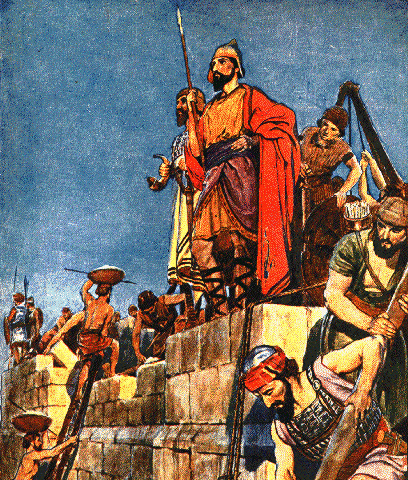
    Leadership From the Wall #4

    Leaders Are Discerning (Nehemiah 6)


    Sanballat and Geshem sent to me, saying, “Come and let us meet together at Hakkephirim in the plain of Ono.” But they intended to do me harm. And I sent messengers to them, saying, “I am doing a great work and I cannot come down. Why should the work stop while I leave it and come down to you?” (Nehemiah 6:2-3 ESV)

    Nehemiah wasn’t fooled by the tricks of the enemy, they were offering now to help with the rebuild and cease opposing its progress. Most leaders may have been excited to see the new change in the opposition, but not Nehemiah. Nehemiah discerned their true and ultimate intention was to harm him, not to help him. I enjoy what Warren Wiersbe says on this matter:

    “Once the enemy gets a foothold in a ministry, he starts to weaken the work from within; and ultimately, the work will fail. While cooperation in the Lord’s work is a noble thing, leaders must take care that they cooperate with the right people at the right time for the right purpose; otherwise they may end up cooperating with the enemy. Satan is a master deceiver and has his servants ready to join hands with God’s people so he can weaken their hands in the work (2 Cor. 11:13–15).” (Wiersbe, 1996, pp. 71-72)

    There is great strength in the denial of help, when we can discern the outcome of such partnering. This reminds me of the city of Pittsburgh and the casino they allowed to be built. The thought was that it will boost the economy, which it has. Yet, the leaders failed to see further down the road than just “the now”. We now have gambling as a city addiction. Once casinos roll in, soon other things begin to creep in like: more drug use, sex trafficking such as prostitution, gambling addictions and more alcohol consumption. In the long run, this casino may in fact be the assistant to helping the City of Pittsburgh go south.

    Nehemiah could tell that these old enemies although they were playing nice now would soon become his enemies again after they “help” rebuild the wall.

    “And I understood and saw that God had not sent him, but he had pronounced the prophecy against me because Tobiah and Sanballat had hired him. For this purpose he was hired, that I should be afraid and act in this way and sin, and so they could give me a bad name in order to taunt me”(Nehemiah 6:12-13 ESV).

    Nehemiah was a discerning leader in more than one instance, here we see him seeing the true person who sent a person to him. He saw that this certain man was not indeed sent by God and that what his words were false. Leaders need to know which people to listen to because it could spell disaster for us in the future if we listen to the wrong people. Here we see Nehemiah discerning the voice to be not from God and we should pray for the same discernment in our own lives. I’ve seen a lot of leaders listening to “Wormtonuge” and not listening to God and in so doing have shipwrecked their leadership roles and the churches they were leading.

    Here, I think the illustration of counterfeit money comes into play. The police force in charge of detecting counterfeit money in order to determine what is counterfeit and what is real study the real money closely. They spend time learning it, understanding it and they have a deep rooted understanding of the real thing. This deep knowledge of the real deal helps them to easily spot that which is fake. When we spend intimate time with the Lord and get to hear His heart beat and allow His Spirit to speak deeply into our lives, we, like Nehemiah will be able to very quickly determine or discern that which is fake. This thought and idea challenges me to become intimate more and more with my Lord, so when a person “not from the Lord” appears in my path with some “direction” I will be able to quickly determine whether or not they are from the Lord.

    Nehemiah’s intimacy with the Lord was directly connected to his intimacy with the Word of God! Warren Wiersbe says: “Nehemiah rejected Shemaiah’s proposal because it was contrary to the Law of Moses. It was forbidden for a layman to go beyond the altar of burnt offering at the temple. “The outsider who comes near shall be put to death” (Num. 18:7, NKJV). When King Uzziah tried to invade the holy precincts, God smote him with leprosy (2 Chron. 26:16–21). Nehemiah knew that Shemaiah was a false prophet because the message he delivered was contradictory to the Word of God”. (Wiersbe, 1996, p. 76)

    Leaders Remember God’s Goodness (Nehemiah 9)

    Nehemiah chapter 9 is all about repenting and remembering the goodness of God. After rediscovering the Word of God in Nehemiah chapter 8, the people realize their own sin and the Goodness of their God. The Law spoke so deeply to their hearts that they realized just how sinful they have become and they had no more reason to be confused about God’s seeming have abandoning them, which of course he didn’t…he simply removed his blessing and allowed them to become captured. This deeper understanding of God’s Word then turned them back to their God and chapter 9 recounts this beautiful turning back. All of this, the Law reading and the repenting were led by Nehemiah. Nehemiah was a man who knew his faults and sins and realized his complete and utter dependence upon the Lord. The entire book is littered with Nehemiah confessing his dependence upon God and how it was God (not himself) that was doing the work of rebuilding and doing the work of allowing the rebuilding to happen. His dependence and confession thereof is a beautiful picture of leadership. We must recognize the goodness of God in gifting us with the abilities we have. We can’t claim our gifts…we had no choice in the matter, God chose and the Holy Spirit delivered those gifts. Nehemiah recognized this and his example caused the entire nation to confess their own junk and in turn remember the goodness of God by recounting aloud his wonderful works!

    Leaders Sign First (Nehemiah 10)

    After the repenting and remembering the goodness of God, the leaders decided that they were going to make a covenant to follow the law. This they would declare to the people of Jerusalem and sign a document in front of them all proving the seriousness in what they were about to undertake. Seeing the severity of their sins and the great goodness of God convicted them to change their lives and the leaders decided to go first. The great thing I notice in chapter 10 is that at the top of the list, #1 is Nehemiah…he signed the document first! This may seem like a small principle of leadership or a small gesture by Nehemiah, but I think it speaks volumes! If God is calling for a change and the leaders feel convicted about the need to make the change…the leaders step up and change first. This is so not only to let the people see that it’s possible, but to assure the people that they as leaders aren’t asking of the people anything that they themselves aren’t willing to do.

    When I was in college and for a time after I worked in the restaurant business as a server and had many managers above me. The managers that worked at Chili’s with me were men who would ask their staff to work harder or do more stuff, or pull their weight more but they themselves were unwilling to do that themselves. Many servers lost respect for these “leaders” and in so doing became lazier then they were before! Leaders who call for change, whether radical or not must be willing to make the change first and like Nehemiah sign the covenant of change before anyone else does.

    Leaders Celebrate Wins (Nehemiah 12)

    “And at the dedication of the wall of Jerusalem they sought the Levites in all their places, to bring them to Jerusalem to celebrate the dedication with gladness, with thanksgivings and with singing, with cymbals, harps, and lyres.” (Nehemiah 12:27, ESV)

    Lastly in the book of Nehemiah I see a leader who celebrates wins. Leaders need to show emotion when things go right, there must be a celebration when we come to the completion of a project and see what the Lord has done. It’s really cool to see the excitement that Nehemiah and the people have at the end when the wall is successfully rebuilt. Not only was the wall built, but God changed the hearts of the people through the building of the wall…that’s something worth celebrating! I have experienced in the church a lack of celebration for what God does, too often we chock it up as normative and ignore the wins that God sends our way. I think this is wrong and I enjoy seeing the recognition here in the book of Nehemiah! I believe that we as leaders need to be more positive and find wins (not making them up mind you, but real live wins) where and when we can and then celebrate them! When we start leading with celebration at what God is doing and has done the people will be spurred on and re-ignited and they will remember the God-task they are on while following the leader!

    I always say to my youth leaders that I am so excited during youth group because I desire to spur my teens on through my excitement: if I’m excited they’ll be excited, but on the other hand if I’m not excited, they won’t be either. Celebrating wins helps us be excited and in turn our flame of excitement will ignite others around us and the work of God can advance all the more!

    As can be seen, there are many leadership principles which come forth in the book of Nehemiah. This book has been an inspiration to me and I know that by the help of the Holy Spirit I hope to implement all of these leadership principles into my own life and leadership.

    Tuesday, October 19, 2010

    Leadership From the Wall #3

    Leaders Delegate (Nehemiah 3; 7:2)


    In chapter 3 of Nehemiah’s book, we see a long list of people doing different things. This can be a boring list of names and jobs but in it, we see a very real and practical leadership/administration principle: Leaders delegate. A Leader can’t get things done alone, this is why he/she casts vision: to get others on board so they can help make the vision come to be. Without people following you, you aren’t a leader. A leaders job is to cast vision, then manage the vision coming to fruition. It’s as John Maxwell says in his book Developing the Leaders Around You “A leader’s success can be defined as the maximum utilization of the abilities of those under him” (Maxwell, p. 15). Nehemiah couldn’t have built a city wall by himself; to try would have been foolish. He needed people around him and he needed to pour into these people the vision and mission of what was to come.

    Nehemiah, we can see was able to rally several people to the cause and also give them specific jobs. Maxwell says that leadership is influence and to a degree, I agree with him and I think in this type of leadership role, Nehemiah had to have a ton of God given influence. Like Maxwell says in Developing the Leaders Around You: “Leadership is influence. Every leader has these two characteristics: (A) he is going somewhere and (B) he is able to persuade others to go with him” (Maxwell, p. 49). Nehemiah needed to be able to persuade people to follow him in order for him to delegate. Again, as we can see in Chapter 3, he was able to do this.

    Along with this idea of delegation, a leader must know who to place where. In Nehemiah 3, we see certain people doing certain jobs. Nehemiah must’ve known who would work best where and so he placed them in their area of strength in order to get the job done to the best of their ability. This also means, that Nehemiah knew the people well enough whom he was leading to put them in their areas of strength! He took the time to assess each individual to then place them where they needed to be. This is a powerful lesson in leadership! We, if we are to be good leaders need to know the people we are leading so we can fit them into the role they can work best in!

    Lastly, this area of delegation shows us that each individual had their own task to complete. Not everyone can do everything and each person needs to be assigned a specific job that only they can do. This creates unity as well as autonomy. People need to feel needed and when they don’t, they jump ship. A perfect example of this (albeit unhealthy) was a guy named Jimmy T. on the recent Survivor show. This guy needed to be needed and when he didn’t feel needed, he unwittingly sabotaged his team. He felt his gifts weren’t being used, so he complained and whined and brought the whole of his team to his sad level. He couldn’t function on a team where he felt unnecessary. Although he was a bit paranoid, the truth of his feelings rings true and every leader needs to learn this lesson of people needing to feel needed. Nehemiah made sure that each person who he was leading had their specific role where they could shine and do their work well.

    Leaders Deal with Opposition (Nehemiah 4 & 6)

    When God uses people to do great things, or when great things are done there will almost always be opposition. The wall to the enemies of the Israelites represented stability and safety and so when they saw great progress being made on the wall, they were angry (Neh. 4:7); “And they plotted together to come and fight against Jerusalem and to cause confusion in it” (Neh. 4:8 ESV). They were going to mess up this progress that was happening in Jerusalem, it was not going to happen on their watch, but God often defies the desires of sinful men!

    Nehemiah knew how to handle this type of opposition and he was ready for it! Once he saw what the enemies of Jerusalem were plotting, he gathered people together to pray. As a leader, he knew he was also a follower of God; he knew his role and sought God for advice. God had asked him to build the wall, so God must have a plan to protect the wall from being destroyed again!

    After praying, Nehemiah came up with a battle plan: set a guard day and night as protection (Neh. 4:9).

    So in the lowest parts of the space behind the wall, in open places, I stationed the people by their clans, with their swords, their spears, and their bows. And I looked and arose and said to the nobles and to the officials and to the rest of the people, “Do not be afraid of them. Remember the Lord, who is great and awesome, and fight for your brothers, your sons, your daughters, your wives, and your homes” (Nehemiah 4:13-14 ESV).

    He also set up people ready to fight and we hear that this frustrated the plans of their enemies (Neh. 4:15). This battle plan stopped their enemies in their tracks, because the Jews were ready to fight when their enemies expected them to be vulnerable while building. However, Nehemiah didn’t rest assured with just frustrating their plans; he insured the safety of his people. Once opposition came and left, he wasn’t under the delusion that it wouldn’t pop up again; in fact he readied his people for it to happen at any moment! He prepared them with weapons as well as a plan of action if some more opposition were to creep up on them.

    From that day on, half of my servants worked on construction, and half held the spears, shields, bows, and coats of mail. And the leaders stood behind the whole house of Judah, who were building on the wall. Those who carried burdens were loaded in such a way that each labored on the work with one hand and held his weapon with the other. And each of the builders had his sword strapped at his side while he built. The man who sounded the trumpet was beside me. And I said to the nobles and to the officials and to the rest of the people, “The work is great and widely spread, and we are separated on the wall, far from one another. In the place where you hear the sound of the trumpet, rally to us there. Our God will fight for us” (Neh. 4:16-20 ESV).

    Nehemiah prepared his people for more trouble and this preparing of his people is a great principle for leadership! We as leaders need to see this principle of leadership and apply it, because we need to prepare our people for opposition and show them how to deal with it when it comes. This may not ring as true in the business world as it does in the ministry world but none-the-less it is a great principle.

    We in church leadership are going against our enemy just by being there and so we must expect opposition to come. It is then upon us to lead our people through opposition and help them through it as well as preparing them for when it comes. Satan is a lion, waiting for his prey (1 Peter 5:8) and God’s people need to know how to have a hammer (to do the work of God) in one hand and a sword (to fight off the enemy) in the other. This picture is one that rings true for the Christian life and we as leaders should be helping the people we lead how to live with the expectation of opposition and give them to tools to fight it.


    Wednesday, October 13, 2010

    Leadership From the Wall #2

    Leaders are Bold (Nehemiah 2:1-8)


    In these verses, we see Nehemiah putting feet and action to his prayers to God. He boldly asks the king if he may go and rebuild the wall that had been destroyed in Jerusalem. This was a bold request because not only did he ask for leave to go and rebuild it, but he asked for help in getting it done. He needed the king’s help in getting the wall built and knew he would have to ask for this help. But as Nehemiah says: “And the king granted me what I asked, for the good hand of my God was upon me” (Nehemiah 2:8b ESV emphasis mine). This reminds me of a statement in Jesus on Leadership where Wilkes makes the statement, “Good leaders cultivate the ability to read current events and thus have a strong sense of what the future may bring” (p. 65). I believe because of Nehemiah’s care and prayer, he was able to foresee that the king would grant his request. He read the current situation well. Nehemiah, during the discussion prayed as well (Neh. 2:4) so as to ensure the time was right and to seek God’s blessing.

    Leaders Assess the Situation (Nehemiah 2:13)

    “I went out by night by the Valley Gate to the Dragon Spring and to the Dung Gate, and I inspected the walls of Jerusalem that were broken down and its gates that had been destroyed by fire”(Neh. 2:13 ESV).

    Nehemiah took the time to see what it was he needed to do before he did it. Good leaders take the time to assess the situations they are in and don’t just rush in and try to fix things. This is a lesson I personally need to learn. I love to rush into things without thinking and without assessing the situation. Generally I have a good sense of what must be done but have no inclination towards the steps to get there unless I sit down and assess the full picture. Too often in my life I have rushed into things and have hindered the progress of getting things done. Nehemiah didn’t make that mistake. He didn’t rush it nor did he cause anyone to freak out. He simply took time out to go and inspect the walls to see what needed to be done. He took stalk in the places that needed extra care and the places that would be quick and easy to rebuild.

    In my limited experience, I’ve seen and heard of pastors getting fired because they tried to rush change. Too many spiritual leaders, like me can see the situation and know where things need to change and be rebuilt, but they don’t usually take the time to assess the whole situation. This has resulted in them leaving by force or by desire because of the lack of simply assessing the situation. Warren Wiersbe says a few things as well on this idea.

    “Investigating (Neh. 2:11–16). After his long difficult journey, Nehemiah took time to rest; for leaders must take care of themselves if they are going to be able to serve the Lord (Mark 6:31). He also took time to get “the lay of the land” without arousing the concern of the enemy. A good leader doesn’t rush into his work but patiently gathers the facts firsthand and then plans his strategy (Prov. 18:13). We must be “wise as serpents” because the enemy is always watching and waiting to attack. (Wiersbe, 1996, p. 30)

    Leaders Cast Vision (Nehemiah 2:17)

    “Then I said to them, ‘You see the trouble we are in, how Jerusalem lies in ruins with its gates burned. Come, let us build the wall of Jerusalem, that we may no longer suffer derision’” (Neh. 2:17 ESV)

    Nehemiah has taken the time to assess the situation, has taken the time to care about these people and has taken the time to pray to ask God what must be done. Finally, he is ready to cast the vision to the people and get them on board with the mission. His steps were deliberate and wise. He didn’t rush into telling them what must be done and how he Nehemiah was going to do it. He took the time to patiently seek the Lord and to patiently see what ought to be done and think through how best to get it done. He casted vision but not prematurely and in a way that rallied the people around the vision.

    Wilkes says: “Leadership begins when a God-revealed mission captures a person” (p. 19) and I believe that the God-revealed mission has captured Nehemiah and he is ready to start working on the rebuilding of the wall. He can now, captured by the vision, perfectly articulate that vision to the people and speak of it in such a way that people can see the end result. It’s as Wilkes said of Jesus “Jesus articulated his mission in order to define what he was as Messiah. Where and how he led flowed from a clear sense of why he had come in the first place…he led with a vision of what things would look like when he completed that mission” (p. 11).

    Saturday, October 9, 2010

    Leadership From the Wall #1

    The book of Nehemiah is chock full of amazing leadership lessons for anyone to glean wisdom from. Nehemiah was a man who cared about his people, loved the name and fame of God and he was a man who was willing to stand in the gap. Leaders who go out of their way to stand in the gap for others shows not only humility but a deep concern for people over production, which when we study the Bible as a whole we see is the very heart of God. God cares more about our hearts than he does our behavior and Nehemiah was a man who cared for the people.


      My next series of blog posts will be a highlighting of the amazing leadership principles which come out of the life and book of Nehemiah!  There is so much to glean from, so I hope you enjoy this as much as I do!  Today, we will highlight Nehemiah 1 and see what we can grab from it's contents with the eye on Leaderhip Principles.

    Leaders care about their people (Nehemiah 1:2-3)

    “… that Hanani, one of my brothers, came with certain men from Judah. And I asked them concerning the Jews who escaped, who had survived the exile, and concerning Jerusalem. And they said to me, ‘The remnant there in the province who had survived the exile is in great trouble and shame. The wall of Jerusalem is broken down, and its gates are destroyed by fire’” (Nehemiah 1:2-3 ESV).

    Nehemiah took the time out of his life to ask how things were going in his home country. He was a cupbearer who was living off of the luxury and dollar of the king, he didn’t need anything from the people of Israel, but he cared enough to ask how they were and how things were going. In his book Be Determined, Warren Wiersbe says:

    “Why would Nehemiah inquire about a struggling remnant of people who lived hundreds of miles away? After all, he was the king’s cupbearer and he was successfully secure in his own life. Certainly it wasn’t his fault that his ancestors had sinned against the Lord and brought judgment to the city of Jerusalem and the kingdom of Judah. … Nehemiah was the man God had chosen to do those very things (Wiersbe, 1996, p. 14)!

    In Nehemiah, we see a man who cared about others. He set his own life aside and jumped in with his life to help his people rebuild the wall. Nehemiah didn’t need to ask about the people, he simply had a natural inclination towards caring about his people. As Warren points out here, Nehemiah’s life was set. Nehemiah didn’t need anyone or anything, much less the need to worry about other people. Many people, left to themselves if they were in a similar situation as Nehemiah would’ve sluffed off the worry about other people and would’ve lived their lives in manner unto themselves.

    This is a great attribute of a good leader. If we are leader of people and do not care about our people and we simply live our leadership life to get ahead for ourselves, we stop being a leader and start being a dictator. Our early picture of Nehemiah shows the type of leader he will show himself to be: one who cares deeply for others.

    Leaders pray (Nehemiah 1:4)

    As soon as I heard these words I sat down and wept and mourned for days, and I continued fasting and praying before the God of heaven. (Nehemiah 1:4 ESV)

    Nehemiah doesn’t simply care for people and leave it there; he goes before the almighty God on their behalf! He prays for them and enters into their pain with them, even though he himself is not really near it. This shows the heart of a leader who is willing to stand in the gap for his people! Great leaders (spiritual or not), if they believe in Jesus Christ should be praying leaders. If we claim that Jesus is our “all in all” yet we don’t ask Him to assist us and those we lead we are simply giving lip-service to a faith that has now bearing in our real life. That may sound harsh but I think it’s true and the sad fact is that in the American church, a praying pastor is something that is lacking. That is poor leadership that makes no sense at all: a spiritual leader who is supposed to lead people towards a deeper faith and knowledge of God spends little to no time with the Lord? How is that possible to then lead people to God?

    This is what Wilkes, in his book Jesus on Leadership would call “and act of submission” and the first step towards servant leadership. Wilkes says: “Submission to God and to the divine mission for your life is the first step to servant leadership” (pg. 22). Nehemiah by praying was seeking the best of others, not himself. When we pray as leaders, we are seeking what God would have us do for Him and for His people, not ourselves. When we lead in this way, we are acting as Jesus did in the capacity of servant leaders.

    Nehemiah didn’t just stop at a simple prayer either; he stood in the gap for the people. He sought their best and asked God to forgive them their sins.

    Leaders Intercede for others (Nehemiah 1:6)

    “Let your ear be attentive and your eyes open, to hear the prayer of your servant that I now pray before you day and night for the people of Israel your servants, confessing the sins of the people of Israel, which we have sinned against you. Even I and my father’s house have sinned” (Nehemiah 1:6 ESV).

    Nehemiah cared enough to not only do a simple prayer for them, but like a priest he interceded for them before God. He went to the Living God and asked Him for mercy upon the people. Leaders care enough to pray for their people in this way. This type of praying for leaders can go a long way with their leadership not only because it trains them to become better prayers but also because it helps them to be tenderer towards the people they lead. There is always a need for a harsh word spoken in love for sure, but there is also a time for tender intercession where we as leaders seek God’s forgiveness of them. While reading this idea of leadership from Nehemiah, I am struck with the reality that I rarely do this for my people. I am convicted by Nehemiah’s example and desire to be a leader who intercedes for the people I lead!

    Nehemiah was also claiming the promise from 1 Kings 8:29; 2 Chron. 7:14 that God would be attentive to the prayers of His people. Warren Wiersbe in his book Be Determined says:

    “The greater part of Nehemiah’s prayer was devoted to confession of sin (1:6–9). The God who promised blessing and chastening also promised forgiveness if His people would repent and turn back to Him (Deut. 30; 1 Kings 8:31–53). It was this promise that Nehemiah was claiming as he prayed for himself and the nation. God’s eyes are upon His people and His ears are open to their prayers (1 Kings 8:29; 2 Chron. 7:14)”. (Wiersbe, 1996, pp. 17-18)

    Again, I feel like this all comes back to the idea of “Servant Leadership” which Wilkes talks about. Nehemiah was humbling himself before God and going before Him on their behalf. He wasn’t caring about himself or what others thought of him, he was simply reaching out to the Almighty God for the people. I like what Wilkes says in his book: “As long as leaders are worried about who sits at the head table, they have little time for the people they are called to serve” (p. 36). This was a statement about not caring how important you are as a leader but how important the people are you are leading. As leaders, we must put the people we serve ahead of ourselves.

    Wednesday, June 23, 2010

    Leadership Fail #3- King Saul

        As We've seen in the previous two posts: Ownership Fail and Listening Fail; Saul has had a ton of "Epic Fail" moments where he dropped the ball BIG time in his time as King over Israel.

      The more I read his story, the more blunders I find.  It's absolutely amazing to me how many "fail" moments he actually had in his leadership.  Several of the fails are similar and end up coming down to the same problem.  Today's Leadership fail (and the final in this series) is no different.  Once Saul began down this path, he continued to make this fail a lifestyle.  In fact, this fail from this point forward defined the rest of his career. 

    Leadership Fail #3- Apprentice Fail

      One of the best new leadership models is the model of Apprenticeship.  It is a model which encourages leaders to reproduce themselves in younger, emerging leaders.  It challenges the old guys to seek out young guys who will bring new life, new vision and new direction to the positions, companies and churches they are leading.

      It is an exciting movement in the leadership world which will help make the future of those positions, companies and churches brighter and more vibrant.  It is also where Saul failed the most in his leadership.

      Saul loved the spotlight, he loved the accolades that were poured onto him as king.  Saul loved power, prestige and butt kissers.  Anything or anyone that made him inferior was something to be pounced on like a lion.  He didn't want to be out-shone, nor did he desire to share the glory with any man...or even God.

      He took credit, owned the glory for himself and tried to kill those who may interfere with his glory.  This was the case with David.

      Saul at first was relieved when David showed up on the scene.  David killed Goliath...but when David started gaining more facebook fans...Saul got a bit peeved.

    "And the women sang to one another as they celebrated,


     "Saul has struck down his thousands, and David his ten thousands."

    And Saul was very angry, and this saying displeased him. He said, "They have ascribed to David ten thousands, and to me they have ascribed thousands, and what more can he have but(C) the kingdom?" And Saul eyed David from that day on." (1 Samuel 18:7-9)

    "And Saul hurled the spear, for he thought, "I will pin David to the wall." But David evaded him twice.

     Saul was afraid of David because the LORD was with him but had departed from Saul." (1 Samuel 18:11-12)

    "And when Saul saw that he had great success, he stood in fearful awe of him." (1 Samuel 18:15)

      Saul had messed up as king, so God had left Saul and stopped giving him favor.  Due to Saul's wicked and unrepentant heart God was forced to choose another king.  God chose David and began showering favor upon David and had His Spirit rest upon David.

      This success peaved Saul off to no end.  Instead of celebrating that God was giving Israel a better king, Saul became jealous and sought to end David's life...further seperating himself from the Lord and the Lord's will.

      I will be the first to admit that as a leader it is hard to see those under you achieving success.  It's hard not because I'm so great but because my sinful nature wants to be better than them.  We judge ourselves in comparison to others.  I've even found myself wondering why someone on facebook has more "friends" than I do....that's pretty freaking low and pathetic!

      However, we are jealous of others success, aren't we?  Someone gets promoted over us, we get ticked.  Someone younger than us gets more accolades for their effort than we do...it makes us freak out, because after all: we've been doing it longer!

      True, honest leadership I'm learning is leadership that develops others.  A strong leader may be effective for 30 or 40 years, but if they invest in the up and comers, they celebrate the success of a younger person and seek to make that person better...they are investing for much longer!  When we apprentice, our skills and our gifts sometimes get transferred...so even if we die off we are still a part of that younger leaders life!  Our influence goes farther!

      Saul sought only his glory and so he jealously kept all his leadership stuff to himself.  There was no attempt to teach a younger guy how to be king.  He hated the success of David and the moment it looked like David was blessed by God to take the throne was the moment Saul went ballistic.

      We as leaders need to be seeking how to invest in the future...even if someone eclipses us in the process...especially in the church!  It's not about us...it's about Him!  Saul as the king over Israel was supposed to be pointing the whole nation to God...instead he was trying to point them to himself.

      His reign was all about his glory...not God's glory.  Saul cared more about his image than he did the image of God.  Brothers ans Sisters, we can't be like Saul! 

    I fail here a ton, I am a people pleaser and I want people to like me, I want the glory, I want the spotlight.

      I, however must die to myself and start pointing to God.  My gifts are His gifts.  My ministry is His ministry.  My wisdom is His wisdom.  We, my friends, are simply stewards of all he has given us.  We don't own anything, not even who we are.  We had no control over who we would be...we simply have a choice to steward that which was given.

      Saul failed in developing an Apprentice.  We should not fail here, God has entrustedd our leadership roles to us to not only lead now, but to lead when we're gone.

    We must look and see: who are the young leaders that have the Lord's Annointing on them?  How can we pick them out and apprentice them for what God has for them in the future?


    Thursday, June 17, 2010

    Leadership Fail #2- King Saul

      King Saul has some huge blunders recorded from his career as king over Israel.  last week we looked at Leadership Fail #1- Ownership Fail
    This week, we will look at Leadership Fail #2 from his life.

    Leadership Fail #2- Listening Fail

      If I'm honest, this is probably one of the biggest struggles I myself have in leadership.  It's one of those leadership fails that attacks and you rarely know it has taken a hold of you.  It is a Leadership Fail that only close friends can point out and only they can walk beside you and help you conquer it.

      It's all about who we listen to and who we desire to please.

      Too often in my life I want everyone to be happy.  I want all the people that surround me in leadership; those above and below me; to be happy with my performance.  I hate criticism, and I dread ticking people off. 

      This is something I am working through, something God is refining me in, so when I share Saul's Fail here, I am very aware that I am looking in the mirror and telling my own story as well as telling myself the answer to getting over this fail.  Here's where Saul began his downward spiral in his position as king over Israel.

    He waited seven days, the time appointed by Samuel. But Samuel did not come to Gilgal, and the people were scattering from him. So Saul said, "Bring the burnt offering here to me, and the peace offerings." And he offered the burnt offering. As soon as he had finished offering the burnt offering, behold, Samuel came.

    And Saul went out to meet him and greet him. Samuel said, "What have you done?" And Saul said, "When I saw that the people were scattering from me, and that you did not come within the days appointed, and that the Philistines had mustered at Michmash, I said, 'Now the Philistines will come down against me at Gilgal, and I have not sought the favor of the LORD.' So I forced myself, and offered the burnt offering." (1 Samuel 13:8-12)

      Saul was supposed to wait for Samuel.  Saul had instructions to wait, but Saul didn't wait.  After he does what he shouldn't have done, Samuel calls him out: "What have you done!?"  Saul then shows to whom he would rather listen to.

      Saul saw his followers, his army, his trusted men going back home. He realized that they weren't please with him and what he was doing at the moment.  The people didn't want to sit around and wait for Samuel so they could worship God.  The people wanted to get away from that place and they were not happy that Saul waited. 

    Some probably tested his kingship with words like: "Look at this king waiting around like a puppy dog for a prophet! Who rules who?  Who really in charge here, Samuel or Saul?"

    The attitude and the voices of the people rang louder in Saul's ears than did the voice of God.  So Saul scrambled to make the people happy, he sped up the process and made a sacrifice to God on his own...even though he was supposed to wait.

    Saul was worried about the people's feelings towards him and Saul was also worried about Samuel.  When Samuel came Saul reveals his heart for trying to make the people happy and he also tries to blame it on God as an after thought.  He says: "...and that the Philistines had mustered at Michmash, I said, 'Now the Philistines will come down against me at Gilgal, and I have not sought the favor of the LORD.' So I forced myself, and offered the burnt offering." (1 Samuel 13:11b-12) 

    Saul, in an effort to appease Samuel says he was worried that if he didn't please God with this sacrifice the Phillistines would be allowed to crush God's people.  He also says: "I made myself do it.  Samuel I struggled and I really didn't want to, you have to see that!  I forced myself to disobey God because I thought I would die if I didn't!"

    Saul needed to worry more about God's command than he did the grumbling and leaving of the people. 

    We as leaders need to do the same.  Our hearts desire should be to please our Father, not His people.  As Shepherds entrusted to steward His flock, we shouldn't listen to the bleating of the sheep but the whisper of our Lord.

      Again as I shared above, I struggle with this fail like no other.  I get frustrated at myself when I notice myself doing it.  I pander, I appease, I've lied, I've wriggled out of things all in an effort to make people happy.  If I don't know an answer to something, I've even made stuff up in an effort to have people think highly of me.

      I can't worry about other people's opinions.  I can't worry about what they think, I need to be close to the Father so I can hear what he desires me to do...and then I do it!

    I do what He asks me to even if: people get ticked; people don't understand; people jeer at me or even if people leave my side because the only voice that matters, the only voice I need to listen to is His voice!

      It can be so easy to please the crowd.  It can be so easy to "go with the flow"...but it can be very difficult to go upstream, against the current.  Sometimes (more often than not) God calls us to go upstream and go after things that may make other people ticked; he often calls us to step on people's toes (in His Name of course) to wake them up from the slumber they are in.

      Sheep like to slumber and as the Shepherds, we need to wake them up!

    I think some practical advise in order to not have this Leadership Fail is our life is:

    1. Yeild our desires to the Holy Spirit
    2. Be ever ready to listen to His voice
    3. Be dilligent to be in the Word to hear from our Chief Shepherd (because we too are dumb sheep in need of waking up)
    4. When God directs, we follow...no matter who may get ticked

    May we take the hind-sight lesson from Saul's life and dedicate our lives to hearing His Voice and following it!